P019 Case File
Juanita Creek Lateral Migration
Citations link to the source document. Reference documents are in the left panel.
About the 3D exhibit. The interactive model beside this summary steps the Juanita Creek wingwall design through its three phases: preliminary, final, and Released for Construction. The comparison table below the model lists the governing elevations by phase. The phase in view is highlighted, and bold marks each value that changed from the prior phase. The scour line moves. The foundation does not.
WSDOT Position Paper - Executive Summary
Protest 019 - Juanita Creek Fish Passage Lateral Migration. Issue SKA-0303. Contract No. 9727, I-405 Brickyard to SR 527 Improvement Project. Draft for internal review.
- January 30, 2026. The Design-Builder sought an Owner-Initiated Change through Skanska LTR 337 ($5,466,392).
- February 24, 2026. WSDOT issued its Interpretive Engineering Decision via WSDOT Serial Letter (SL) No. 9727-280.
- March 10, 2026. The Design-Builder filed its Notice of Protest (Skanska LTR 372).
- March 24, 2026. The Design-Builder filed its supplemental Written Statement (Skanska LTR 384, $4,615,622).
- April 14, 2026. WSDOT issued its Written Determination (WSDOT SL No. 9727-326).
- April 28, 2026. The Design-Builder filed its Notice of Dispute (Skanska LTR 417, $3,179,809).
1. The Matter Referred to the Board
Was the Design-Builder's decision to assume lateral migration and design the Juanita Creek wingwalls for full scour depth its engineering judgment in performing the contractual scour analysis, or a change directed by WSDOT's review comments and Fish Passage Task Force discussions?
2. WSDOT's Position
The lateral migration assumption and the full-scour-depth wingwall design were the Design-Builder's engineering judgment in performing the scour analysis the Contract assigns to it. WSDOT did not direct that design, and its cost rests with the Design-Builder. No Owner-Initiated Change is warranted.
3. The Design Was the Design-Builder's Responsibility, Not a WSDOT-Directed Change
1. The scour analysis was the Design-Builder's contractual obligation. Technical Requirements (TR) 2.30.5.6 Scour Analysis assigns it to the Design-Builder:
The Design-Builder shall perform a scour analysis that includes all habitat and stream restoration components ... The analysis shall include the risk of Lateral Migration (Structural), potential for long-term degradation, and evaluation of Total Scour.
The Design-Builder performed it, found the risk "low to moderate," found the geotechnical data "not sufficient to exclude the risk of lateral migration," and assumed migration to occur. It did so in its Preliminary Submittal of the Final Hydraulic Design of June 2024, before any WSDOT comment on the subject. Its Engineer of Record confirmed in a June 13, 2025 email that "to be conservative, lateral migration was assumed," and that the tunnel and wingwalls were "designed for full scour depth."
The comment the Design-Builder points to as the source of this design, FHD RCSR Comment 196, did not issue until February 19, 2025. It observed that the Design-Builder's own hydraulic evidence supported a conclusion that the migration risk was "not low" and invited the Design-Builder to revise "if this is not correct." Because the Design-Builder had already assumed lateral migration and designed the wingwalls for full scour depth in its June 2024 Preliminary Submittal of the Final Hydraulic Design, roughly eight months before Comment 196, the comment cannot be the origin of that design.
2. A "low" classification of the risk of lateral migration does not erase the need to perform scour analysis, and scour controls over its depth. Table 2.30-B classifies the level of the lateral migration risk as low. It is not a finding of no migration. The precedence the Design-Builder relies on is not absolute. TR 2.30.5.2.1 Certain Structure and Channel Design Characteristics gives Table 2.30-B precedence only "except as otherwise specified," and the Contract specifies otherwise for scour:
When specifications for scour require foundations to be deeper than allowed by the Controlling Bottom Elevation of the SFZ, the scour specifications shall control.
Total scour, which WSDOT Bridge Design Manual (BDM) Section 8.1.10 Scour of Retaining Walls defines to include the effects of lateral migration, therefore controls over the "low" classification. The classification states the level of the risk. It does not excuse the TR 2.30.5.6 analysis.
3. Review comments did not amend the Contract or direct a change. General Provisions (GP) 1-02.1 Responsibility for Design provides that comments on Design Documents do not amend the Contract or relieve the Design-Builder of design responsibility, with no exception for tone or wording. The Design-Builder casts the East Portal structural comment as a directive because it says "shall":
East Portal RCSR Comment 4. The foundation for all walls constructed along rivers and streams shall be evaluated during design by the Hydraulics Engineer for total scour ... The bottom of the wall foundation and bottom of wall elements ... shall be located a minimum of 2 feet below the total scour at the check flood. Also see Figure 8.1.10-2.
That "shall" is not the reviewer's. Comment 4 reproduces the operative requirement of the Mandatory Standard it cites:
BDM 8.1.10 Scour of Retaining Walls. The foundation for all walls constructed along rivers and streams shall be evaluated during design by the Hydraulics Engineer for total scour ... shall be located a minimum of 2 feet below the total scour at the check flood elevation in accordance with the Geotechnical Design Manual Section 15-4.5 unless a greater depth is otherwise specified.
A comment that quotes a Mandatory Standard and asks the Design-Builder to confirm its design meets it enforces the Contract. It does not amend it. Authority to direct the Design-Builder rests solely with the WSDOT Engineer under GP 1-05.1 Authority, Review, and Oral Orders, and no authorized direction was issued. The only lateral migration guidance the Design-Builder's Engineer of Record points to is guidance to disregard lateral migration, and the record does not identify who is said to have given it. Guidance to disregard it is the opposite of a directive to design for it.
4. Lateral migration and scour did not drive the wingwall foundation or the tunnel. The structural plans show the wingwall embedment is set by retained wall height and global stability, not by scour. At the East Portal the preliminary plans (BY-CRE-02210) already carried the deep soldier-pile foundation before any bottom-of-scour line was drawn. The final plans (BY-CRE-03543) first added that line, at EL 214.23, with the wall bottom set 2 feet below it, and the piles nearest the headwall deepened from 19 to 24 feet as the wingwall and headwall grew taller, not as scour changed. The Released for Construction plans then raised the bottom of scour about 10 feet, to EL 224.25, with no change to the foundation. The West Portal shows the same pattern: the embedment held at 25 to 26.5 feet, pile-for-pile identical across the preliminary, final, and Released for Construction plans (BY-CRE-02327, BY-CRE-03550, BY-CRE-04750), and the bottom of fascia held at EL 201.63, even as the bottom of scour was raised about 7 feet, from EL 203.63 to EL 210.81. A foundation that does not move when the scour line moves 7 to 10 feet is not governed by scour. As to the tunnel, the Design-Builder's January 16, 2026 presentation states lateral migration "did not impact depth of sediment in tunnel."
5. No WSDOT-Initiated Change, and the IED stands. GP 1-04.4(1) WSDOT-Initiated Changes requires WSDOT to authorize and require a change, and no verbal nor Written Change Order issued. The Interpretive Engineering Decision was properly issued under GP 1-03.5 Ambiguities and Interpretive Engineering Decisions on February 24, 2026, which provides that no such decision forms the basis for a price or time increase and that the Design-Builder bears the burden of proving WSDOT's interpretation incorrect or unreasonable.
4. Recommendations Sought From the DRB
That WSDOT's review comments and Task Force discussions were design review of the Design-Builder's Design Documents and did not amend the Contract, relieve the Design-Builder of its design responsibility, or constitute a WSDOT-Initiated Change.
That the scour analysis was the Design-Builder's obligation under TR 2.30.5.6, that designing the wingwalls for full scour depth was an exercise of its engineering judgment, and that the Table 2.30-B "low" classification did not remove that obligation.
That the Design-Builder is not entitled to an increase in the Contract Price or an extension of the Contract Time on Protest 019.
Summary of the WSDOT Position Paper for the Dispute Review Board. See the complete Position Paper for full context.
WSDOT Position Paper
Dispute Review Board Pre-Hearing Submittal
Contract No. 9727 - I-405, Brickyard to SR 527 Improvement Project
Protest 019 - Issue SKA-0303 - Juanita Creek Fish Passage Lateral Migration Design
1. Introduction
Pursuant to General Provisions (GP) 1-04.5(1) Disputes, WSDOT submits this position paper and the referenced supporting documents to the Dispute Review Board (DRB or Board) for its consideration of the matter referred by the Design-Builder on Protest 019.
The Design-Builder performed a scour analysis for the Juanita Creek fish passage that accounted for lateral migration, and designed the headwall and wingwalls accordingly. The Design-Builder now contends that WSDOT's review comments on the Design-Builder's hydraulic and structural Design Documents, together with discussions at Fish Passage Task Force meetings, directed that design and therefore constitute an Owner-Initiated Change.
Statement of the Matter Referred to the Board. The matter referred to the Board is whether the Design-Builder's decision to assume lateral migration and design the Juanita Creek wingwalls for full scour depth was its own engineering judgment in performing the contractual scour analysis, or a change directed by WSDOT's review comments and Fish Passage Task Force discussions. The Board's recommendation is requested on whether a Change Order is warranted.
Three provisions bear on this question: the scour-analysis requirement (Technical Requirements (TR) 2.30.5.6 Scour Analysis), the lateral migration risk classification for Juanita Creek (Table 2.30-B), and the effect of WSDOT review comments on the Design-Builder's design responsibility (GP 1-02.1 Responsibility for Design). The parties disagree over how they apply to the lateral migration design. Those provisions, the technical and documentary record, and WSDOT's position are set out in the Sections that follow.
The full sequence of correspondence and design submittals on this issue, with dates and sources, is set out in the chronology at Section 5. In summary, the Design-Builder issued Skanska LTR 337 (Request for Direction) on January 30, 2026, WSDOT issued its Interpretive Engineering Decision (WSDOT SL No. 9727-280) on February 24, 2026, the Design-Builder filed its Notice of Protest via Skanska LTR 372 on March 10, 2026 and its supplemental Written Statement via Skanska LTR 384 on March 24, 2026, WSDOT issued its Written Determination (WSDOT SL No. 9727-326) on April 14, 2026, and the Design-Builder filed its Notice of Dispute via Skanska LTR 417 on April 28, 2026, the fourteenth day of the dispute window under GP 1-04.5(1), expressly requesting referral of this matter to the Board. WSDOT submits this position paper in response.
2. Project Summary
The I-405, Brickyard to SR 527 Improvement Project is a design-build project for highway and multimodal improvements along the I-405 corridor in the cities of Bothell and Kirkland, Washington. The Work includes the correction of fish passage barriers at six stream crossings identified in TR 2.30 Water Crossings, in compliance with the federal culvert injunction.
Juanita Creek (I-405 milepost 21.94, Fish Passage and Diversion Screening Inventory site 998602) is one of those crossings. The Design-Builder designed a new injunction-compliant, fish-passable crossing at Juanita Creek consisting of a three-sided buried structure with a headwall and wingwalls, together with a regraded and restored stream channel. The Design-Builder is the Engineer of Record for the hydraulic and structural design of that crossing.
3. Relevant Contract Provisions
This Section sets out the contract language that governs this matter. Each provision is quoted as it appears in the Contract Documents. Except where noted, each is a Contract Document. The WSDOT Bridge Design Manual, which contains Section 8.1.10, is a Mandatory Standard, as explained in Section 3.9. Defined terms used in WSDOT's position appear first, in Section 3.1.
3.1 Defined Terms
The following terms are defined in TR 2.30 and are used in this position paper. Each is quoted as it appears in the Contract.
Lateral Migration (Structural):
"Lateral migration of the stream channel in a manner that cuts into side slopes or hillsides above the floodplain to the extent that threatens the integrity of the roadway or structure or the loading conditions which are defined in the structural design code as a result of erosion or scour of the side slopes."
"the meaning as defined by FHWA Hydraulic Engineering Circular Number 18 (HEC-18) evaluated at the Scour Design Flood and Scour Check Flood."
Scour Design Flood:
"The discharge (flood) resulting from storm, storm surge, tide, or some combination thereof having a flow rate equal to or less than the 100-year discharge (flood) or the 2080 100-year projected discharge (flood) (if it has been deemed practicable to do so), that creates the deepest scour at structure foundations."
Scour Check Flood:
"The discharge (flood) resulting from storm, storm surge, tide, or some combination thereof having a flow rate in excess of the scour design flood, but in no case a discharge (flood) with a recurrence interval exceeding the greater of the typically used 500-year or the 2080 100-year projected discharge (flood) (if it has been deemed practicable to do so), that creates the deepest scour at structure foundations."
Structure Free Zone (SFZ), in part:
"An imaginary, rectangular prism of infinite length both upstream and downstream, that is horizontally centered on the Bearing of Stream, parallel to the Bearing of Stream, and which represents the minimum boundary within which no part of the fish passage structure, including footings, shall be allowed unless meeting the criteria for an allowable exception in this paragraph. The SFZ is bounded on top and bottom by the CTE and the CBE respectively, with minimum interior width equal to the minimum SFZ Width specified in Table 2.30-B."
Controlling Bottom Elevation (CBE), in part:
"An imaginary surface that represents the bottom boundary of the Structure Free Zone (SFZ) as depicted in the SFZ Drawings in this Section."
3.2 GP 1-02.1 Responsibility for Design
"It is the intent of the Contract Documents that the Design-Builder undertake full responsibility for delivery of the Project. The Contract Documents do not provide details of the design necessary to carry out the intent of the Contract Documents. Such detailed designs are the sole responsibility of the Design-Builder to develop."
GP 1-02.1 further provides:
"Notwithstanding anything in the Contract Documents to the contrary, no field explanations or interpretations provided by WSDOT at any meetings, and no comments by WSDOT on Design Documents or Released for Construction (RFC) Documents, shall be deemed, construed, or interpreted to (a) amend, supersede, or alter the terms, requirements, limitations, or meaning of any Contract Document or (b) release or relieve the Design-Builder from full responsibility for the design of the Project in accordance with the Contract Documents."
This provision addresses the effect of WSDOT meeting explanations and WSDOT comments on Design Documents. It is a Contract Document.
3.3 GP 1-03.5 Ambiguities and Interpretive Engineering Decisions
As to a defect the Design-Builder discovers in the Contract Documents:
"The Design-Builder shall not take advantage of any apparent error, omission, inconsistency, or other defect in the Contract Documents. The Design-Builder shall promptly notify WSDOT of any error, omission, inconsistency, or other defect that the Design-Builder may discover in the Contract Documents, and shall obtain specific instructions in writing from the WSDOT Engineer regarding any such error, omission, inconsistency, or other defect before proceeding with the Work affected thereby."
As to Interpretive Engineering Decisions:
"The Design-Builder may, from time-to-time, request in writing that WSDOT provide information, clarifications, and interpretations of ambiguous or uncertain design requirements set forth in the Contract Documents (an Interpretive Engineering Decision). WSDOT may issue a Written approval of the Design-Builder's proposed Interpretive Engineering Decision (if any), may issue its own Interpretive Engineering Decision or may disapprove any Interpretive Engineering Decision the Design-Builder proposes."
As to price and time:
"no Interpretive Engineering Decision by WSDOT shall form the basis for an increase in the Contract Price or extension of the Contract Time, unless WSDOT expressly provides otherwise in writing."
As to the burden of proof:
"the Design-Builder shall bear the burden of proving that WSDOT's interpretation is incorrect or unreasonable."
This provision imposes a notification duty on the Design-Builder, authorizes WSDOT to issue an Interpretive Engineering Decision, addresses its effect on price and time, and allocates the burden of proof. It is a Contract Document.
3.4 GP 1-03.7 Approvals and Acceptances
"The oversight, spot checks, audits, reviews, tests, and inspections conducted by WSDOT do not constitute approval nor acceptance of the materials or Work inspected or reviewed."
The same Section provides that the Design-Builder:
"at all times shall have an independent duty and obligation to fulfill the requirements of the Contract Documents."
This provision addresses the effect of WSDOT review and non-action on the Design-Builder's obligations. It is a Contract Document.
3.5 GP 1-04.1 Intent of Contract
"WSDOT and the Design-Builder both intend for the Design-Builder to assume full responsibility and liability with respect to the design of the Project, including correction of any errors, omissions, inconsistencies, or other defects in the Conceptual Design, subject only to the Design-Builder's right to a Change Order for Necessary Basic Configuration Changes."
GP 1-04.1(1):
"Compensation for all risks and contingencies assigned to the Design-Builder under the Contract Documents."
This provision allocates design responsibility and the associated cost. It is a Contract Document.
3.6 GP 1-04.4(1) WSDOT-Initiated Changes
"WSDOT reserves the right to authorize and require changes in the Work within the general scope of the Contract as provided herein."
The same Section also provides:
"Changes in the Design Documents by the Design-Builder to meet Contract requirements or correct deficiencies, that do not materially change the Technical Proposal, are the responsibility of the Design-Builder and are not considered a change in the Work. No adjustment will be allowed to Contract Price or Contract Time for such changes."
This provision identifies what constitutes a WSDOT-Initiated Change and what does not. It is a Contract Document.
3.7 GP 1-04.4(5) Matters Not Eligible for Change Orders
GP 1-04.4(5) makes certain matters the Design-Builder's exclusive responsibility, including at subsection (b):
"Any design changes required by WSDOT as part of the process of reviewing the Design Documents for consistency with the requirements of the Contract Documents, except to the extent directly attributable to errors, omissions, inconsistencies, or other defects in the Basic Configuration as provided herein."
This provision assigns to the Design-Builder the cost of design changes made through the design review process, with a single exception for defects in the Basic Configuration. It is a Contract Document.
3.8 GP 1-05.1 Authority, Review, and Oral Orders
Authority to act for WSDOT on the Project rests with the WSDOT Engineer:
"The WSDOT Engineer represents WSDOT on the Project, with full authority to enforce Contract requirements and carry out WSDOT's orders."
A WSDOT approval or recommendation does not bind WSDOT or relieve the Design-Builder:
"If the WSDOT Engineer approves or recommends any method or manner for doing the Work or producing materials, the approval or recommendation shall not: 1. Guarantee that following the method or manner will result in compliance with the Contract 2. Relieve the Design-Builder of any risks or obligations under the Contract 3. Create any WSDOT liability."
GP 1-05.1(1) Oral Orders provides:
"When the Design-Builder believes they have received an oral order, the Design-Builder shall notify the WSDOT Engineer in writing and within 3 Calendar Days... Failure to follow procedures of this Section will result in a waiver of claim."
This provision identifies who holds authority to direct the Design-Builder, limits the effect of a WSDOT review or recommendation, and sets out the procedure the Design-Builder must follow if it believes it has received an oral order. It is a Contract Document.
3.9 TR 2.13.4 Foundation Cover for Scour and BDM 8.1.10
TR 2.13.4 Design Criteria:
"Minimum foundation cover requirements for scour shall be in accordance with the WSDOT Bridge Design Manual. Existing structure foundations including spread footings, pile caps, shaft caps (or bottom of seal if used), and wall elements (including fascia panels, lagging, leveling pads, and footings) affected by the Work shall meet the minimum foundation cover requirements or be protected against scour to that level."
TR 2.13.2.1 Bridge Design Manual Rights and Responsibilities:
"All Chapters of the WSDOT Bridge Design Manual shall be followed as a part of the Mandatory Standard."
WSDOT Bridge Design Manual (BDM) Section 8.1.10 Scour of Retaining Walls:
"Total Scour includes the amount of streambed vertical elevation drop at a given location due to the removal of streambed material caused by flowing water and the effects of lateral migration."
BDM 8.1.10 sets out three design figures: Figure 8.1.10-1 for scour without lateral migration, Figure 8.1.10-2 for scour with lateral migration, and Figure 8.1.10-3 for scour with lateral migration and scour countermeasures. The Bridge Design Manual is a Mandatory Standard and a Contract Document. TR 2.13.2.1 requires that all of its chapters be followed as part of the Mandatory Standard, and it is listed as a Contract Document in Appendix D. Foundation cover for scour is incorporated through TR 2.13.4.
3.10 TR 2.30.5.2.1 Table 2.30-B and Channel Design Characteristics
TR 2.30.5.2.1 Certain Structure and Channel Design Characteristics:
"The Design-Builder shall comply with the requirements of Table 2.30-B. Except as otherwise specified, where a conflict exists between Table 2.30-B and another Contract requirement, the requirements of Table 2.30-B shall take precedence."
Table 2.30-B states, for I-405 milepost 21.94 (Juanita Creek):
"Is the risk of Lateral Migration (Structural) low? ... Yes"
TR 2.30.5.2.1 and Table 2.30-B establish the lateral migration risk classification for the crossing. They are Contract Documents.
3.11 TR 2.30.5.6 Scour Analysis
"The Design-Builder shall perform a scour analysis that includes all habitat and stream restoration components in accordance with the Mandatory Standards and this Section. The analysis shall include the risk of Lateral Migration (Structural), potential for long-term degradation, and evaluation of Total Scour (long-term degradation, contraction scour, and local scour)."
The same Section assigns the Design-Builder the following evaluations:
"The Design-Builder shall make a determination of the presence of erodible soils in the streambed... This information is used to help determine the extents of vertical and lateral scour limits."
"The Design-Builder shall perform an evaluation of historical/existing conditions versus expected future conditions with the proposed stream design. Primarily, the analysis shall evaluate what the expected Lateral Migration (Structural) will be in the future, based on how the stream may adjust over the life of the structure."
"The Design-Builder shall locate, design and construct any required scour countermeasures (e.g., rock revetment) or scour protection wall to protect various WSDOT infrastructure components against total scour, including Lateral Migration (Structural). This includes an assessment of where the stream may move laterally (e.g., determining angles of attack) and vertically in relation to the various WSDOT infrastructure components."
TR 2.30.5.6 assigns the scour analysis, the lateral migration evaluation, and the scour countermeasure design to the Design-Builder. It is a Contract Document.
4. Discussion
This Section sets out the technical and documentary record. Section 7 sets out WSDOT's position.
4.1 The Design-Builder's Hydraulic Design and Lateral Migration Assessment
The Design-Builder assumed lateral migration in its hydraulic design for Juanita Creek before any WSDOT comment on the subject.
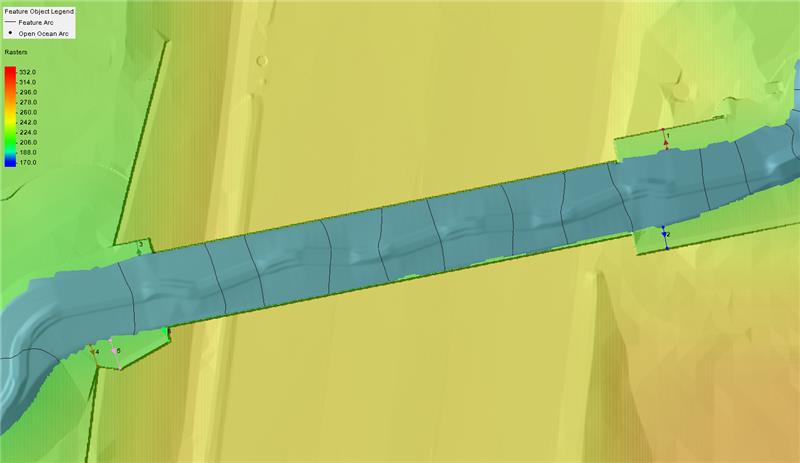
The Preliminary Hydraulic Design (PHD, June 2024) found that "there is low to moderate potential for lateral migration within the project reach," and stated that "although the risk for lateral migration is considered low to moderate, the risk in relation to the structure is assumed to occur for the purposes of scour analysis and estimation of total scour." It added that "the geotechnical data available at this time are not sufficient to exclude the risk of lateral migration from the scour analysis" pending detailed geotechnical evaluation of soil erodibility over the life of the structure. WSDOT's review of the Preliminary Hydraulic Design raised no comment on lateral migration.
The Design-Builder submitted its Final Hydraulic Design (FHD) on January 28, 2025. Section 7 of the FHD documents the scour analysis, and Appendix O documents a lateral migration rapid assessment. The FHD carried the same low-to-moderate finding forward in the same terms, including that the risk "is assumed to occur for the purposes of scour analysis and estimation of total scour" and that the geotechnical data were "not sufficient to exclude the risk of lateral migration from the scour analysis." The Design-Builder's Appendix O states that the rapid assessment method from FHWA Hydraulic Engineering Circular No. 20 (HEC-20) was used to rate the migration potential of Juanita Creek, and that "the results of the rapid assessment indicate that Juanita Creek has low potential for lateral or vertical migration." The assessment recorded field observations including bank erosion, noting that "bank erosion was encountered in various locations along Juanita," and a bank soil texture of gray silty sand.
The Design-Builder's hydraulic design therefore recorded its own determination, on its own data, to account for lateral migration in the scour analysis for the Juanita Creek structure. That treatment was consistent from the preliminary design through the final design, and WSDOT's review comments first addressed lateral migration at the Final Hydraulic Design stage, after the Design-Builder had adopted the assumption.
4.2 The Design Review Comments
WSDOT provided comments on the Design-Builder's Design Documents through the Resolution of Comments and Submittal Review (RCSR) process.
On the Final Hydraulic Design, the comment the Design-Builder identifies as central is FHD RCSR Comment 196, by WSDOT reviewer DJS on Section 7.1 of the report. Comment 196 reads in full:
"a) Could you make your conclusion clear and complete based on the info you have, 2) Pleased the term "NOT low" is used. Based on what I read, it seems like this should be your summary. "Based on the available geologic and geomorphic understanding described in section 2, the risk of lateral migration is NOT low. The existing sediments/soils in the bed and banks are considered erodible. Beavers/beavers dams are present in the watershed. It is possible that the channel could shift or change. We were not able to determine the amount the channel has changed historically." if this is not correct, please revise"
The Design-Builder responded, "To be revised for RFC submittal," coding the comment for resolution at the Released for Construction stage, and WSDOT's backcheck accepted that disposition. Comment 196 does not contain the word "shall."
The Design-Builder contends that other review comments used mandatory "shall" language and thereby directed the lateral migration design. Skanska LTR 384 states that WSDOT "issued RCSR comments that directed the Design-Builder to incorporate lateral migration analysis," and that "under WAC 162-08-017, 'Shall' expresses a command." The comments the Design-Builder cites are the East Portal preliminary structural Comments 3 and 4. Comment 3 reads:
"See BDM 8.1.10 Scour of Retaining Walls These wing walls (both 3 & 4) are parallel to the stream alignment and are subject to total scour along the entire length of the wall. Please confirm bottom of wall is 2 feet below total scour at check flood elevation; including lateral migration (structural)."
Comment 4 reads:
"BDM 8.1.10 Scour of Retaining Walls The foundation for all walls constructed along rivers and streams shall be evaluated during design by the Hydraulics Engineer for total scour in accordance with LRFD-BDS and Hydraulic Engineering Circular No. 23 (HEC-23). The bottom of the wall foundation and bottom of wall elements such as, the fascia panel, lagging, leveling pad, footing, pile cap or shaft cap shall be located a minimum of 2 feet below the total scour at the check flood. Also see Figure 8.1.10-2"
Comment 3 asks the Design-Builder to "confirm" its design. The word "shall" appears in Comment 4, in text quoted from BDM 8.1.10, and Comment 4 refers the Design-Builder to Figure 8.1.10-2. The Design-Builder responded to both comments that the requirement was met and that the drawings were "updated for East Portal final submission." WSDOT's backcheck held both comments open, stating it "Cannot resolve without review of updated drawings/plans," pending the final submittal.
No RCSR comment in the record references the Table 2.30-B lateral migration classification.
On the West Portal preliminary structural design, the Design-Builder identifies Comment 25:
"At the joint between the wingwall and existing MSE wall at both wingwall ends scour requirements for the new and old portion of the MSE apply."
Comment 25 addresses the scour requirements at the joint between the new wingwall and the existing MSE wall. The subject carried into the West Portal final review, where the comments on that interface, Comments 7 and 10, were dispositioned "T," transferred to the final hydraulic design then in progress.
4.3 The June and July 2025 Methodology Correspondence
Between June 13 and July 25, 2025, the Design-Builder's Engineer of Record and WSDOT's hydraulics reviewer exchanged a series of emails regarding the lateral migration methodology. WSDOT placed the complete thread in the record on April 14, 2026.
In an email dated June 13, 2025, the Design-Builder's Engineer of Record wrote that "to be conservative, lateral migration was assumed when conducting scour analysis." The same email states that "both tunnel and wingwalls are designed for full scour depth." The same email states that the Engineer of Record initiated the discussion "in response to a structural comment from Jason Pang related to protection of the downstream MSE at Juanita Creek."
On June 18, 2025, the Design-Builder proposed a 46-foot valley width derived from a nine-cross-section analysis. WSDOT's hydraulics reviewer responded the same day that the reviewer agreed with the Design-Builder's "estimate of lateral migration extents and documentation" and asked that it be included in the final FHD. Later the same day, the Design-Builder wrote that "we will use this as a guide to design buried riprap following HEC-23 to protect the MSE wall."
The Fish Passage Task Force minutes for July 1, 2025 record that "lateral migration defined as low in Chapter 2 still requires the limits to be determined." The minutes for July 15, 2025 record that the "Contract defines lateral migration at Juanita Creek as low and will be followed." WSDOT completed its review of the lateral migration comments on July 28, 2025 and noted the availability of the Design-Builder Initiated Change process under GP 1-04.4(2). WSDOT's reviewer recorded that the comments were resolved "on behalf of HQ hydraulics due to the contract terms surrounding low lateral migration."
4.4 The Design-Builder's January 2026 Presentation and Request for Direction
The Design-Builder's Sediment Depth Discussion presentation, dated January 16, 2026, was attached to Skanska LTR 337, which the Design-Builder issued on January 30, 2026 as a Request for Direction seeking an Owner-Initiated Change of $5,466,392.
The presentation states that "the final design of the wingwalls and headwall was completed before we received guidance to ignore lateral migration." Addressing the tunnel, it states that the lateral migration treatment "did not impact depth of sediment in tunnel." Addressing the buried riprap, it states that "this buried riprap is not connecting to or protecting the new structure" and that "it is protecting an existing MSE wall downstream of the structure."
The presentation also records an exchange between Skanska and the Design-Builder's Engineer of Record. On slide 8, Skanska asked why lateral migration was included at Juanita Creek, noting that it had "fought so hard to not include lateral migration at the Sammamish River but seemed to accept it here," and the Engineer of Record's reply again placed the cited FHD before that guidance. On slide 9, asked to "depict ... how WSDOT influenced the design," the Engineer of Record stated the treatment "did impact wingwall design" and "may have been different if received guidance on lateral migration sooner," and that a redesign would have required "significant effort."
The asserted amount has been stated three times. Skanska LTR 337 sought $5,466,392. Skanska LTR 384 stated $4,615,622. Skanska LTR 417 states $3,179,809. The Design-Builder has stated in Skanska LTR 384 and Skanska LTR 417 that the progress schedule analysis is "underway." No progress schedule analysis has been provided.
5. Sequence of Events and Chronology
| Date | Event | Source |
|---|---|---|
| July 3, 2024 | Design-Builder submits the Preliminary Hydraulic Design for Juanita Creek | BY-CRE-00858 |
| July 30, 2024 | WSDOT returns the Preliminary Hydraulic Design comments. No lateral migration comment at this stage | BY-CRE-00858 |
| January 28, 2025 | Design-Builder submits the Final Hydraulic Design | BY-CRE-01827 |
| February 19, 2025 | WSDOT returns the Final Hydraulic Design comments | RCSR (BY-CRE-01827) Comment 196 |
| March 2025 | Design-Builder submits the preliminary East Portal wall plans. WSDOT returns the structural review comments citing the Bridge Design Manual | RCSR (BY-CRE-02210) Comments 3 and 4 |
| March 2025 | Design-Builder submits the preliminary West Portal wall plans. WSDOT returns the structural comment on the new-wingwall-to-existing-MSE-wall joint | RCSR (BY-CRE-02327) Comment 25 |
| June 13, 2025 | Engineer of Record email. Lateral migration "assumed when conducting scour analysis." Tunnel and wingwalls "designed for full scour depth" | 500-year flood extents figure (June 13, 2025 email) |
| June 18, 2025 | Design-Builder proposes 46-foot valley width. WSDOT concurs the same day. Design-Builder selects buried riprap per HEC-23 | Methodology email thread |
| July 1, 2025 | Task Force minutes: "low ... still requires the limits to be determined" | Fish Passage Task Force minutes, July 1, 2025 |
| July 2025 | Design-Builder submits the final West Portal wall plans. The MSE-wall interface comments are transferred to the hydraulic design | RCSR (BY-CRE-03550) Comments 7 and 10 |
| July 15, 2025 | Task Force minutes: the contract definition of low lateral migration will be followed | Fish Passage Task Force minutes, July 15, 2025 |
| July 28, 2025 | WSDOT closes the lateral migration RCSR comments consistent with the "low" classification, identifying the Design-Builder Initiated Change process (GP 1-04.4(2)) to depart from it | WSDOT SL No. 9727-280 Section 4 |
| October 2025 | Design-Builder submits the final East Portal wall plans. The dispositioned form does not re-raise the Bridge Design Manual scour comments, and the surviving scour comment is accepted | RCSR (BY-CRE-03543) Comment 16 |
| December 31, 2025 | Released for Construction issued for the East Portal headwall and wingwalls. The West Portal wall structures are Released for Construction in the same period | BY-CRE-04325, BY-CRE-04750 |
| January 30, 2026 | Request for Direction seeking $5,466,392 | Skanska LTR 337 |
| February 24, 2026 | Interpretive Engineering Decision on Juanita Creek lateral migration | WSDOT SL No. 9727-280 |
| March 10, 2026 | Notice of Protest 019 | Skanska LTR 372 |
| March 16, 2026 | WSDOT acknowledges Protest 019. Supplemental due March 24, 2026 | WSDOT SL No. 9727-294 |
| March 24, 2026 | Supplemental Written Statement. Amount $4,615,622 | Skanska LTR 384 |
| April 14, 2026 | Written Determination | WSDOT SL No. 9727-326 |
| April 28, 2026 | Notice of Dispute. Amount $3,179,809. DRB referral requested | Skanska LTR 417 |
6. Submittals
This Section identifies the relevant design submittals and the WSDOT review comments on each. Each submittal is paired with its complete Resolution of Comments and Submittal Review (RCSR) form, which records every comment, the Design-Builder's response, the WSDOT backcheck, and the final disposition. The submittals themselves, across their preliminary, final, and Released for Construction versions, each with its complete review comment form, are collected in Appendix N.
6.1 Preliminary Hydraulic Design (BY-CRE-00858)
The Design-Builder submitted the Preliminary Hydraulic Design for Juanita Creek, dated June 2024, on July 8, 2024. Section 7.1, at page 63, recorded that "although the risk for lateral migration is considered low to moderate, the risk in relation to the structure is assumed to occur for the purposes of scour analysis and estimation of total scour," and that "the geotechnical data available at this time are not sufficient to exclude the risk of lateral migration from the scour analysis until detailed geotechnical data ... is available to support the assessment of no lateral migration being anticipated over the life (75+ years) of the proposed structure." WSDOT returned its review comments on July 30, 2024 and raised no comment on lateral migration. The Design-Builder had assumed lateral migration in the scour analysis before any WSDOT comment on the subject.
The summary table of the same report, at page 73, records under floodplain continuity the entry "Lateral migration: No," cross-referenced to Section 2.7.4 Channel Migration. It records "Scour countermeasures: Determined at FHD."
6.2 Final Hydraulic Design (BY-CRE-01827)
The Design-Builder submitted the Final Hydraulic Design on January 28, 2025, carrying the same lateral migration assumption, with the scour analysis in its Section 7. Section 7.1 of the final report, at page 73, reproduces the preliminary report's lateral migration paragraph word for word, including the statement that the geotechnical data remained "not sufficient to exclude the risk of lateral migration." The geotechnical investigation the preliminary report identified as the means of resolving the question had not been completed in the six months between the two reports.
Table 9-1 of the final report, the Report Summary at page 83, carries the same entry as the preliminary report, "Lateral migration: No," cross-referenced to Section 2.7.4 Channel Migration. The scour countermeasures entry changed from "Determined at FHD" to "No," consistent with Section 8, which states that "no countermeasures are recommended to protect the abutments from scour at the Juanita Creek crossing of I-405."
WSDOT returned its comments on February 19, 2025, including FHD review Comment 196. The Design-Builder responded that the conclusion was "To be revised for RFC submittal," and WSDOT's backcheck accepted that disposition. WSDOT resolved the lateral migration comments on July 28, 2025, recording that lateral migration at Juanita Creek "is defined as low and shall be followed" and that the Design-Builder would "otherwise need a DBIC." Status: comments resolved July 28, 2025.
6.3 East Portal Wall Structures (BY-CRE-02210, BY-CRE-03543, BY-CRE-04325)
The Design-Builder submitted the preliminary East Portal wall plans (BY-CRE-02210) in March 2025. WSDOT returned preliminary review Comments 3 and 4, both citing BDM 8.1.10. The Design-Builder responded that the requirement was met and that the drawings were "updated for East Portal final submission," and WSDOT's backcheck held both comments open, stating it "Cannot resolve without review of updated drawings/plans," pending the final plans. The Design-Builder submitted the final plans (BY-CRE-03543) in October 2025. The dispositioned final review comment form did not re-raise BDM 8.1.10, and the one surviving scour-geometry comment, Comment 16 on anchor exposure, was resolved and accepted. The design was Released for Construction (BY-CRE-04325) in December 2025. Status: Released for Construction.
6.4 West Portal Wall Structures (BY-CRE-02327, BY-CRE-03550, BY-CRE-04750)
The Design-Builder submitted the preliminary West Portal wall plans (BY-CRE-02327) in March 2025. WSDOT returned Comment 25, citing BDM 7.1.7, on the scour requirements at the joint between the new wingwall and the existing MSE wall. The Design-Builder submitted the final plans (BY-CRE-03550) in July 2025. On the final form, the comments on that interface, Comments 7 and 10, were dispositioned "T," transferred to the final hydraulic design then in progress. The design was Released for Construction (BY-CRE-04750). Status: Released for Construction.
7. WSDOT Position
In response to the matter referred to the Board, framed in Section 1, WSDOT's position is that the Design-Builder's assumption of lateral migration and design of the Juanita Creek wingwalls for full scour depth was the Design-Builder's own engineering judgment in performing the contractual scour analysis. WSDOT did not direct it, and the cost of the Design-Builder's design judgments rests with the Design-Builder.
WSDOT's position rests on the contract provisions in Section 3 and the record in Section 4. Each line of reasoning below connects a fact in the record to a provision of the Contract.
7.1 Lateral Migration Analysis Requirement
The Contract assigns the scour analysis to the Design-Builder. TR 2.30.5.6 provides that "the Design-Builder shall perform a scour analysis" that "shall include the risk of Lateral Migration (Structural)," that "the Design-Builder shall make a determination of the presence of erodible soils," that "the Design-Builder shall perform an evaluation of ... what the expected Lateral Migration (Structural) will be in the future," and that "the Design-Builder shall locate, design and construct any required scour countermeasures ... against total scour, including Lateral Migration (Structural)."
The Design-Builder performed that analysis. In its Final Hydraulic Design, it rated the migration potential of Juanita Creek using the rapid assessment method from FHWA Hydraulic Engineering Circular No. 20 (HEC-20), documented in Appendix O, and recorded field observations of bank erosion and erodible bank soils. The analysis found "low to moderate potential for lateral migration within the project reach." The Design-Builder did not treat that finding as a basis to exclude lateral migration. It found the available geotechnical data "not sufficient to exclude the risk of lateral migration from the scour analysis," and so assumed the risk to occur for the purposes of the scour analysis. Its Engineer of Record wrote, in a June 13, 2025 email, that "to be conservative, lateral migration was assumed when conducting scour analysis," and that "both tunnel and wingwalls are designed for full scour depth." Five days later, on June 18, 2025, the Engineer of Record proposed a 46-foot average valley width as the outer limit of channel migration, derived from nine cross sections, and wrote in the same email that "the tunnel and wingwalls are designed for full scour depth and do not require scour protection," proposing the migration extents instead for the design of scour protection at the existing mechanically stabilized earth wall downstream. WSDOT accepted the valley width the same morning: "This looks good. Thank you. I agree with your estimate of lateral migration extents and documentation. Please include this information in the final FHD." The record contains no WSDOT rejection of a lateral migration calculation the Design-Builder submitted. The decision to assume lateral migration and to design the wingwalls for full scour depth was the Design-Builder's own conservative engineering judgment, made in performing the scour analysis the Contract assigns to it. Under GP 1-02.1, the detailed design of the Project is "the sole responsibility of the Design-Builder to develop." That judgment, and the design that followed from it, are not a WSDOT-Initiated Change.
The Design-Builder reached this judgment before any WSDOT comment on lateral migration. It assumed lateral migration in its Preliminary Hydraulic Design (June 2024), which recorded that "although the risk for lateral migration is considered low to moderate, the risk in relation to the structure is assumed to occur for the purposes of scour analysis and estimation of total scour," and WSDOT's review of that report raised no lateral migration comment. It carried the same assumption into its Final Hydraulic Design (January 2025), which set the wingwall scour at full depth. WSDOT responded with comment on the Final Hydraulic Design in February 2025. The structural design followed the Design-Builder's own hydraulic design. The preliminary structural plans submitted in March 2025 state that the structure "has been designed for scour in accordance with the hydraulic report dated June 2024," and the final structural plans update that basis to the "final hydraulic report dated January 2025." The lateral migration design basis was in place, and keyed to the Design-Builder's own hydraulic reports, before WSDOT commented on it.
7.2 Low Risk and Scour Analysis
Table 2.30-B asks a single question for each crossing: "Is the risk of Lateral Migration (Structural) low?" For Juanita Creek, the answer is "Yes." That answer classifies the level of the lateral migration risk as low. It is the reference point for this Section.
The Design-Builder treats that "low" answer as if it removed the obligation to analyze and design for lateral migration. Its argument rests on the precedence clause in TR 2.30.5.2.1, under which "the requirements of Table 2.30-B shall take precedence." But the same clause gives Table 2.30-B that precedence only "except as otherwise specified," and the Contract specifies otherwise for scour. Where scour requires a foundation deeper than the Controlling Bottom Elevation of the Structure Free Zone (SFZ), or set back farther from the stream than the SFZ Width allows, "the scour specifications shall control." BDM 8.1.10 provides that "Total Scour includes ... the effects of lateral migration," and TR 2.30.5.6 requires the Design-Builder to assess "where the stream may move laterally ... in relation to the various WSDOT infrastructure components." So where that total scour, lateral migration included, requires a deeper or farther foundation than the fish passage envelope would allow, the scour requirement controls and the envelope yields. The Design-Builder's argument inverts that rule, letting the "low" classification cap the scour design the Contract makes controlling.
A classification of "low" also does not remove the analysis. It states the level of the risk. It is not a finding of no migration, and it does not remove the obligation to evaluate the migration's effect on the structure. TR 2.30.5.6 separately requires the Design-Builder to include "the risk of Lateral Migration (Structural)" in the scour analysis and to evaluate what the expected future lateral migration will be at the structure. The classification and the total scour obligation operate together. The contract text supports both at once and identifies no conflict between them, and there is no provision under which a "low" classification excuses the Design-Builder from the TR 2.30.5.6 analysis or from the BDM 8.1.10 total scour evaluation. GP 1-03.2 Order of Precedence operates only where an actual conflict exists, and a low risk classification does not conflict with the obligation to evaluate and design for total scour.
The cost of the design follows the same allocation of responsibility. Whether the lateral migration design is viewed as part of the scour analysis the Contract required or as a conservative measure the Design-Builder elected, it is design work. GP 1-04.1(1) provides that the Contract Price includes "compensation for all risks and contingencies assigned to the Design-Builder", and detailed design is the Design-Builder's sole responsibility under GP 1-02.1. A design the Design-Builder performed to satisfy or exceed the Contract's requirements is within the Contract Price, not a basis for a Change Order.
7.3 Review Comments Do Not Amend the Contract or Direct a Change
The Design-Builder characterizes WSDOT's RCSR comments as direction. GP 1-02.1 addresses that characterization directly. It provides that "no comments by WSDOT on Design Documents or Released for Construction (RFC) Documents, shall be deemed, construed, or interpreted to (a) amend, supersede, or alter the terms, requirements, limitations, or meaning of any Contract Document or (b) release or relieve the Design-Builder from full responsibility for the design of the Project." GP 1-02.1 makes no exception based on the tone, the wording, or the practical effect of a comment. It applies to all comments on Design Documents.
Examined individually, the comments the Design-Builder cites are ordinary design review, not directives.
Hydraulic Design (Comment 196). Comment 196 went to how the Design-Builder stated its risk conclusion, not to the scour the walls were designed for. The Design-Builder's own Final Hydraulic Design recorded erodible bank soils and found the geotechnical data "not sufficient to exclude the risk of lateral migration," while its rapid assessment in Appendix O scored the migration potential "low." Comment 196 pointed to that mismatch, observed that the Design-Builder's own evidence supported a conclusion that the risk was "NOT low," and invited the Design-Builder to revise "if this is not correct." That is design review of the Design-Builder's own analysis, framed as a question the Design-Builder was free to answer. The Design-Builder had already assumed lateral migration occurs and set the wingwall scour at full depth on that assumption, independent of whether the written conclusion read "low" or "not low." A comment on the wording of the conclusion did not change that scour.
East Portal (Comments 3 and 4). Comments 3 and 4 cite BDM 8.1.10 by name and ask the Design-Builder to confirm compliance with it. The word "shall" in those comments is quoted from the Mandatory Standard, not added by WSDOT. BDM 8.1.10 provides that "the foundation for all walls constructed along rivers and streams shall be evaluated during design by the Hydraulics Engineer for total scour," and Comment 4 refers the Design-Builder to the Manual's Figure 8.1.10-2. A comment that quotes a Mandatory Standard and asks the Design-Builder to confirm its design meets it enforces the Contract. It does not amend it.
West Portal (Comment 25). Comment 25 stated that, at the joint between the new wingwall and the existing MSE wall, "scour requirements for the new and old portion of the MSE apply," citing BDM 7.1.7. The Design-Builder casts this comment as having re-triggered the lateral migration issue and directed new work. It did neither. The existing MSE wall is affected by the Work, and TR 2.13.4 requires that existing wall elements affected by the Work "meet the minimum foundation cover requirements or be protected against scour to that level." Comment 25 states that existing requirement for the affected wall. It is not a new direction.
The Design-Builder's reliance on WAC 162-08-017 for the proposition that "'Shall' expresses a command" does not change this. That regulation is a definitional rule in the practice and procedure of the Washington State Human Rights Commission, governing administrative proceedings under RCW 49.60. It does not govern the interpretation of this Contract. The general rule that "shall" is mandatory is in any event a canon of statutory construction, and Washington courts interpret contracts by their terms, not by statutory canons. And the only "shall" in the cited comments is the one quoted from BDM 8.1.10, which commands the designer to evaluate total scour. It is not a command WSDOT added.
A review comment cannot direct the Work in any event. Authority to direct the Design-Builder rests with the WSDOT Engineer. GP 1-05.1 provides that the WSDOT Engineer "represents WSDOT on the Project, with full authority to enforce Contract requirements and carry out WSDOT's orders." A review comment is not an exercise of that authority. GP 1-05.1 confirms that a WSDOT approval or recommendation does not "Guarantee that following the method or manner will result in compliance with the Contract," does not "Relieve the Design-Builder of any risks or obligations under the Contract," and does not "Create any WSDOT liability." The WSDOT Engineer issued no authorized direction to account for lateral migration.
To the extent the Design-Builder contends that the comments or the Task Force discussions amounted to an oral order, GP 1-05.1(1) required the Design-Builder, when it "believes they have received an oral order," to "notify the WSDOT Engineer in writing and within 3 Calendar Days." The record contains no such notice.
The Contract also addresses the circumstance the Design-Builder actually pleads, which is that conditions at Juanita Creek required designing for lateral migration notwithstanding the Table 2.30-B classification. That is an assertion that a Contract Document was inconsistent with the site. GP 1-03.5 provides that the Design-Builder "shall promptly notify WSDOT of any error, omission, inconsistency, or other defect that the Design-Builder may discover in the Contract Documents, and shall obtain specific instructions in writing from the WSDOT Engineer regarding any such error, omission, inconsistency, or other defect before proceeding with the Work affected thereby." If the Design-Builder regarded the classification as inconsistent with the site, that provision states the route available to it. The record contains no such notice, and the Design-Builder proceeded through both preliminary structural submittals, both final submittals, release of the East Portal for construction, and fabrication of its piles.
7.4 Lateral Migration and Scour Did Not Drive the Wingwall Foundation
The Design-Builder attributes its asserted cost to lateral migration and scour driving the depth of the wingwall foundation. The structural plans do not bear that out. They show that scour does not govern the wingwall embedment, and that the comments the Design-Builder cites did not create the foundation it built.
What the scour requirement is. BDM 8.1.10 requires that the bottom of the wall foundation, and bottom wall elements such as the footing and pile cap, "shall be located a minimum of 2 feet below the total scour at the check flood." Total scour is the streambed elevation drop from the removal of material and the effects of lateral migration. At Juanita Creek the Final Hydraulic Design calculated a total scour of 0.65 foot at the design flood and 1.16 feet at the check flood. Table 7-4 of that report, at page 81, reports the components:
| Calculated scour component | Scour design flood | Scour check flood |
|---|---|---|
| Long-term degradation (ft) | 0.12 | 0.12 |
| HEC-18 contraction scour (ft) | 0 | 0 |
| NCHRP 24-20 contraction and abutment scour (ft) | 0.53 | 1.04 |
| Total depth of scour (ft) | 0.65 | 1.16 |
| WSDOT minimum scour depth (ft) | 3 | 3 |
The Final Hydraulic Design states the basis for the minimum at Section 7.5: "Per the WSDOT Hydraulics Manual (WSDOT 2022a), a minimum scour depth of 3 feet shall be used for all 3-sided water crossing structures. Because the estimated total scour is less than 3 feet, the minimum value is reported for total scour." The scour requirement therefore reaches about 5 feet below the streambed: 3 feet of governing scour plus the 2-foot cover. That is the entire depth scour adds to the foundation.
Scour does not govern the embedment. The wingwall piles are embedded far deeper than scour requires, and the plans show the embedment does not track the scour line. On the East Portal the preliminary plans already carried the deep soldier-pile foundation, embedded 17 to 19 feet, before any bottom-of-scour line was drawn. The final plans first added the explicit bottom-of-scour line, at EL 214.23, and set the bottom of the wall fascia 2 feet below it, at EL 212.23, meeting the Bridge Design Manual. At the Released for Construction stage the bottom of scour was then raised about 10 feet, to EL 224.25, without changing a single pile. The West Portal proves the same point. Every West wingwall pile carries 25 to 26.5 feet of embedment in every version of the plans in which it appears. The wall configuration did change between the preliminary and final plans, with pile WW2-04 added and the outer wall sections drawn taller, but no pile's embedment changed with it. The final and Released for Construction schedules are identical pile for pile, and the bottom of fascia held at EL 201.63, even though the bottom-of-scour elevation there was raised about 7 feet at the Released for Construction stage, from EL 203.63 to EL 210.81. The scour line moved 7 to 10 feet and the foundation did not move at all. A foundation that ignores a 7-to-10-foot change in the scour line is not a foundation that scour governs. These embedments are set by the retained height of the wall and by global stability, the demands that deepen a soldier-pile toe as the wall grows taller. Scour adds only its roughly 5-foot allowance to a foundation embedded 17 to 26 feet.
The scour comments did not drive the foundation. Because scour does not govern the embedment, the comments that asked the Design-Builder to confirm its scour cover did not drive it either. Comment 3 asked the Design-Builder to "confirm bottom of wall is 2 feet below total scour at check flood elevation," including lateral migration (structural). The preliminary plans already carried the deep soldier-pile foundation, on the basis of the Design-Builder's own hydraulic design, before any bottom-of-scour line was drawn. At the final submittal the Design-Builder added the explicit bottom-of-scour line and set the bottom of the wall fascia 2 feet below it, documenting compliance with the Mandatory Standard. The three East Portal wingwall piles nearest the headwall were deepened by five feet in that same revision, which also raised the wingwall design height, and the deepening tracks the added height. It cannot be a scour response: at the Released for Construction stage the bottom of scour was raised about 10 feet and not one pile changed. A comment asking the Design-Builder to confirm its wall met a Bridge Design Manual figure did not create that foundation. The Design-Builder had already placed it well below the scour line on the basis of its own hydraulic design.
The Design-Builder's own supplemental corroborates this. Skanska LTR 384 records that the Design-Builder "revert[ed] to the baseline design," which it describes as "a conservative approach (i.e., full scour depth)," and that the wingwall depths in the final and Released for Construction submittals held to that baseline. The full scour depth was the Design-Builder's own baseline, carried from its hydraulic design, not an increase a review comment produced. The asserted "up to 15 feet additional depth" is not borne out by the Design-Builder's own submittal record.
7.5 No WSDOT-Initiated Change
A WSDOT-Initiated Change has a defined contractual form. GP 1-04.4(1) provides that "WSDOT reserves the right to authorize and require changes in the Work." The record contains no Written Change Order and no order from WSDOT authorizing and requiring a change to the lateral migration design. The same Section provides that design changes by the Design-Builder "to meet Contract requirements or correct deficiencies ... are the responsibility of the Design-Builder and are not considered a change in the Work."
7.6 Interpretive Engineering Decisions
The Design-Builder contends that WSDOT SL No. 9727-280 is not a proper Interpretive Engineering Decision because the Design-Builder did not request it. GP 1-03.5 provides that WSDOT "may issue its own Interpretive Engineering Decision". No request by the Design-Builder is required.
The Design-Builder further contends that the letter refuses entitlement rather than interpreting the Contract, and so is not a true Interpretive Engineering Decision. The substance controls over the label. WSDOT SL No. 9727-280 interprets the Contract, applying TR 2.30.5.6, Table 2.30-B, and BDM 8.1.10 to the lateral migration design, and it is in any event a Written Determination issued under GP 1-04.5 in response to Skanska LTR 337. Its conclusion that no Change Order is warranted is the result of that interpretation, not a substitute for it.
Two further provisions of GP 1-03.5 govern the consequence. First, "no Interpretive Engineering Decision by WSDOT shall form the basis for an increase in the Contract Price or extension of the Contract Time, unless WSDOT expressly provides otherwise in writing". WSDOT has not provided otherwise. Second, the Design-Builder "shall bear the burden of proving that WSDOT's interpretation is incorrect or unreasonable". The Design-Builder's reading, under which a "low" classification removes the TR 2.30.5.6 analysis obligation and the BDM 8.1.10 total scour obligation, is not supported by the text of either provision.
7.7 No Constructive Direction
Skanska LTR 384 advances a theory of "constructive direction," under which the cumulative effect of review comments operated as direction even though no single comment did. The Contract does not recognize that theory. GP 1-02.1 applies to "no comments," without limitation as to number or cumulative effect, and GP 1-04.4(1) requires WSDOT to "authorize and require" a change. The contractual line is the presence or absence of a WSDOT directive, and the record contains none.
GP 1-04.4(5) places the cost of design review changes on the Design-Builder, subject only to changes "directly attributable to ... defects in the Basic Configuration." The Design-Builder has not asserted such a defect, and none exists here. The design changes it describes are attributable to its own scour analysis under TR 2.30.5.6.
The Design-Builder also had contractual avenues if it believed a comment exceeded the Contract. GP 1-04.5 provides a protest procedure with a 14-calendar-day window, and GP 1-04.4(2) provides a Design-Builder Initiated Change process. The Design-Builder proceeded through the preliminary, final, and Released for Construction stages of the wall design over approximately ten months without invoking either on the lateral migration comments.
The Design-Builder's argument that it had no practical discretion, because comment resolution was a prerequisite to Release for Construction, does not change this. That a comment must be resolved before Release for Construction is a feature of the review process for every comment. It does not convert the content of a comment into a change in the Work. Comments 3 and 4 asked the Design-Builder to confirm its wall met BDM 8.1.10, an existing Mandatory Standard, which asks only that the Design-Builder meet the Contract. The review enforces the Contract. It does not enlarge it.
WSDOT's review of the design did not convert the Design-Builder's own judgment into a compensable change. GP 1-03.7 provides that WSDOT's "oversight, spot checks, audits, reviews, tests, and inspections ... do not constitute approval nor acceptance," and that the Design-Builder "at all times shall have an independent duty and obligation to fulfill the requirements of the Contract Documents." The cost of the Design-Builder's own design judgment rests with the Design-Builder under GP 1-02.1 and GP 1-04.1.
7.8 The Record Shows Review and Concurrence, Not Rejection or Reversal
Skanska LTR 384 describes a five-month sequence in which WSDOT is said to have rejected the Design-Builder's methodologies and then reversed position. The contemporaneous record does not support that description. In a June 18, 2025 email, the Design-Builder proposed a 46-foot valley width, and WSDOT's reviewer concurred the same day, agreeing with the Design-Builder's "estimate of lateral migration extents." That is concurrence with the Design-Builder's own analysis, not rejection of it.
The record shows no methodology rejected. The Design-Builder proposed the valley width approach, the 500-year extents, and the figure selections, and WSDOT evaluated and concurred. The Design-Builder's supplemental confirms the point against its own interest. It states that the design "has continuously met Contract requirements" and that its approach using BDM Figure 8.1.10-1 "meets the contract requirements." An approach the Design-Builder proposed, that WSDOT concurred in, and that the Design-Builder maintains met the Contract throughout, is not a WSDOT-directed change.
The July statements are consistent with one another and with the Contract. The July 1, 2025 minutes state that a "low" classification "still requires the limits to be determined," and the July 15, 2025 minutes state that the "Contract defines lateral migration at Juanita Creek as low and will be followed." Read together, they state that the lateral migration classification is "low" and that the scour analysis obligation under TR 2.30.5.6 remains. WSDOT's engagement with the scour analysis between February and July 2025 was review of the Design-Builder's TR 2.30.5.6 obligation. It was not a change to the Table 2.30-B classification, which was never at issue.
The Design-Builder's own presentation is consistent with WSDOT's position and is internally inconsistent with the position the Design-Builder now advances. The January 16, 2026 Sediment Depth Discussion presentation states that the design "was completed before we received guidance to ignore lateral migration," which places the Design-Builder's lateral migration design ahead of the guidance it now characterizes as direction. The same presentation states that lateral migration "did not impact depth of sediment in tunnel," which is inconsistent with the assertion in Skanska LTR 384 that lateral migration extended scour through the full width and depth of the tunnel.
The presentation undermines the theory that WSDOT directed the Design-Builder to design for lateral migration. The only guidance on lateral migration the Design-Builder points to is guidance to disregard it. Guidance to disregard lateral migration is the opposite of a directive to design for it. The contrast Skanska itself draws confirms the design was the Design-Builder's own. At the Sammamish River, classified "not low," the Design-Builder "fought so hard to not include" lateral migration. At Juanita Creek, classified "low," its Engineer of Record designed for it anyway. A Design-Builder that resisted lateral migration at the "not low" structure did not need to be directed to design for it at the "low" one.
Asked by Skanska to depict how WSDOT influenced the design, the Engineer of Record did not say WSDOT directed it. On slide 9 of the presentation, it said the design "may have been different if received guidance on lateral migration sooner," conceding that no guidance arrived in time to shape it. The Engineer of Record's acknowledgment that the treatment "did impact wingwall design" describes the effect of the Design-Builder's own scour assumption, not a change WSDOT made. The "significant effort" a later revision would have taken is the cost of revising a design the Design-Builder had already chosen.
7.9 Consistency with the Sammamish River Crossing
The Design-Builder contends that WSDOT's position here is inconsistent with its position at the Sammamish River crossing, where WSDOT applied a "not low" lateral migration designation. There is no inconsistency. At both crossings WSDOT applies the contract classification as written. The Contract designates the Sammamish River crossing as "not low," and WSDOT applied that designation. More specifically, the Contract states that the Sammamish River "not low" determination "shall apply to the new structures within the river flow limits defined by the 500-year flood elevation." That is an added mandate, particular to Sammamish, that WSDOT enforced. Its absence at Juanita Creek removes only that Sammamish-specific add-on. It does not remove the default scour analysis obligation under TR 2.30.5.6 or the BDM 8.1.10 total scour standard, which apply at every crossing. The Contract designates Juanita Creek as "low" in Table 2.30-B, and the Design-Builder's own scour analysis under TR 2.30.5.6 accounted for lateral migration at the structure. The two crossings carry different contract classifications. WSDOT enforced the Contract as written at each.
7.10 The Asserted Cost and Schedule Impacts Are Unsupported
The asserted entitlement has no contractual basis for the reasons above, which makes the amount moot. WSDOT notes four further points for the record.
The lateral migration comments were resolved on July 28, 2025, and the design was Released for Construction on December 31, 2025. The Design-Builder first sought an Owner-Initiated Change for this work through Skanska LTR 337 on January 30, 2026, approximately six months after the comments were resolved and after the costs were committed. The record contains no contemporaneous notice that the Design-Builder regarded the lateral migration work as a WSDOT-directed change for which it would seek payment.
GP 1-04.5 provides that the Design-Builder's supplemental Written Statement shall include "an analysis of the progress schedule showing the schedule change or disruption" where the Design-Builder asserts a schedule change. No such analysis has been provided in Skanska LTR 384 or Skanska LTR 417.
Skanska LTR 417 introduces cost elements that were not in the supplemental Written Statement, including a stream realignment cost element. WSDOT understands this matter to be confined to the circumstances and bases set out in Skanska LTR 384, the supplemental Written Statement.
The Design-Builder's own cost figures do not reconcile. Skanska LTR 384 lists the AECOM design cost at $125,544, while the AECOM supplement and its PCN 153 record the same cost at $109,169, a difference of $16,375 that the supplemental does not explain. The asserted total depends on the higher figure.
The structural record bears on the magnitude of the asserted cost. The wingwall foundation depth is governed by the retained height and global stability, not by scour. The asserted cost is therefore not attributable to a scour-depth increase, which the plans do not show.
8. Conclusion
WSDOT's position is as follows.
The Contract assigned the scour analysis at Juanita Creek to the Design-Builder under TR 2.30.5.6. The Design-Builder's own analysis found the lateral migration risk "low to moderate" and the data insufficient to exclude it, and the Design-Builder made the conservative engineering judgment to assume lateral migration and design the wingwalls for full scour depth. That judgment was the Design-Builder's own, as its Final Hydraulic Design and its June 13, 2025 email confirm.
The Table 2.30-B "low" classification, the TR 2.30.5.6 scour analysis obligation, and the BDM 8.1.10 total scour standard operate together. A "low" classification does not remove the obligation to analyze and design for lateral migration.
WSDOT's review comments did not amend the Contract or direct a change. GP 1-02.1 provides that comments on Design Documents do not alter the Contract or relieve the Design-Builder of design responsibility. Authority to direct the Design-Builder rests with the WSDOT Engineer under GP 1-05.1, and no authorized direction was issued.
The lateral migration analysis and scour design did not drive the depth of the wingwall foundation or the tunnel. The structural plans show that scour does not govern the wingwall embedment, which is set by the retained height and global stability. As to the tunnel, the Design-Builder's own presentation states that lateral migration "did not impact depth of sediment in tunnel." The asserted cost is not attributable to a scour-depth increase that the plans do not show.
The Interpretive Engineering Decision was properly issued under GP 1-03.5, which provides that no Interpretive Engineering Decision forms the basis for a price or time increase and that the Design-Builder bears the burden of proving WSDOT's interpretation incorrect or unreasonable.
The Design-Builder is not entitled to an Owner-Initiated Change. GP 1-04.4(1) requires WSDOT to authorize and require a change, and no Written Change Order issued. The design is the Design-Builder's own, and its cost is within the Contract Price under GP 1-02.1 and GP 1-04.1.
9. Recommendations Sought From the DRB
WSDOT respectfully requests that the Board find and recommend as follows.
That WSDOT's review comments and Task Force discussions on the Juanita Creek lateral migration design were design review of the Design-Builder's Design Documents and did not amend the Contract, did not relieve the Design-Builder of its design responsibility, and did not constitute a WSDOT-Initiated Change.
That the scour analysis at Juanita Creek was the Design-Builder's obligation under TR 2.30.5.6, that the Design-Builder's decision to assume lateral migration and design the wingwalls for full scour depth was its own engineering judgment, and that the Table 2.30-B "low" classification did not remove the scour analysis obligation.
That the Design-Builder is not entitled to an increase in the Contract Price or an extension of the Contract Time on Protest 019.
10. List of Attachments
| Attachment | Description |
|---|---|
| A | WSDOT SL No. 9727-280, Interpretive Engineering Decision (February 24, 2026) |
| B | Skanska LTR 372, Notice of Protest 019 (March 10, 2026) |
| C | Skanska LTR 384, Supplemental Written Statement (March 24, 2026) |
| D | WSDOT SL No. 9727-326, Written Determination (April 14, 2026) |
| E | Skanska LTR 417, Notice of Dispute (April 28, 2026) |
| F | Cited contract provisions: GP 1-02.1, GP 1-03.5, GP 1-03.7, GP 1-04.1, GP 1-04.4, GP 1-04.5, GP 1-05.1, TR 2.13.2.1, TR 2.13.4, TR 2.30.5.2.1, Table 2.30-B, TR 2.30.5.6 |
| G | WSDOT Bridge Design Manual Section 8.1.10 Scour of Retaining Walls, and FHWA Hydraulic Engineering Circular No. 18 (HEC-18) Evaluating Scour at Bridges |
| J | June 13 to July 25, 2025 email thread on lateral migration methodology |
| K | Fish Passage Task Force minutes, July 1 and July 15, 2025 |
| L | Design-Builder Sediment Depth Discussion presentation (January 16, 2026) |
| N | Design submittals, consolidated by submittal across the preliminary, final, and Released for Construction versions. Each submittal is paired with its complete RCSR review comment form, showing all comments, the Design-Builder's responses, and the final dispositions. Former Attachments H, I, and M are folded in here. |
Appendix N is organized as follows. Each item pairs the submittal with its complete review comment form (all comments and responses).
| Item | Description |
|---|---|
| N1 | Juanita Creek Preliminary Hydraulic Design Report (BY-CRE-00858), paired with its complete review comment form (PHD RCSR, all comments and responses) |
| N2 | Juanita Creek Final Hydraulic Design, Section 7 Final Scour Analysis, Section 8 Scour Countermeasures, and Appendix O Lateral Migration Rapid Assessment, paired with the complete FHD review comment form (all 215 comments and responses, including Comment 196) and the July 28, 2025 comment closure email |
| N3 | East Portal wall structures: preliminary plans (BY-CRE-02210) paired with its complete review comment form (Comments 3 and 4), final plans (BY-CRE-03543) paired with its complete dispositioned review comment form (Comment 16), Released for Construction plans (BY-CRE-04325), and the wall elevation progression |
| N4 | West Portal wall structures: preliminary plans (BY-CRE-02327) paired with its complete review comment form (Comment 25), final plans (BY-CRE-03550) paired with its complete dispositioned review comment form (Comments 7 and 10), Released for Construction plans (BY-CRE-04750), and the wall elevation progression |
INTERNAL MEMO -- DO NOT SEND
Purpose: This memo documents WSDOT's analysis of Protest 019 (Skanska LTR 372) for internal use and DRB preparation. It contains internal reasoning, argument rebuttals, and strategic analysis not for external distribution.
KEY FINDING: DESIGN REVIEW, NOT DIRECTION
The RCSR comments were design review feedback, not Owner-Initiated direction.
Comment 196 (the critical comment Skanska cites) is WSDOT telling AECOM that their own technical evidence supports a "NOT low" conclusion. This is design review, not an OIC. The IED characterization of SL 9727-280 is defensible.
New arguments in LTR 372 (IED characterization, WAC 162-08-017, Section 1-02.1 shield, P003 consistency) do not change this conclusion. Each fails on independent grounds analyzed in Section III.
EVALUATION FRAMEWORK
WSDOT's evaluation addresses three questions:
- Did WSDOT direct a change, or did WSDOT point out what the Design-Builder's analysis showed?
- Is there a distinction between BDM 8.1.10 (retaining wall scour) and Table 2.30-B (fish passage lateral migration)?
- What procedural and contractual defenses apply?
Finding: The Design-Builder's own analysis supported "NOT low" conditions. WSDOT reviewers pointed this out. The IED is properly issued. No OIC is warranted. Protest should be denied.
I. CONTRACT FRAMEWORK
A. Table 2.30-B and Section 2.30.5.2.1
Table 2.30-B designates Juanita Creek (I-405 MP 21.94) lateral migration (structural) as "low." This designation has not been overridden.
Section 2.30.5.2.1 establishes that Table 2.30-B designations "shall apply" and takes precedence. WSDOT's position in both P003 (Sammamish) and P019 (Juanita) enforces the contract as written. The Table 2.30-B designation stands.
B. BDM 8.1.10: Scour of Retaining Walls (Separate Mandatory Standard)
BDM Section 8.1.10 states:
"Total Scour includes the amount of streambed vertical elevation drop at a given location due to the removal of streambed material caused by flowing water and the effects of lateral migration."
The BDM provides three figures:
- Figure 8.1.10-1: Scour without Lateral Migration
- Figure 8.1.10-2: Scour WITH Lateral Migration (cited in Package 9 Comment 4)
- Figure 8.1.10-3: Scour with Lateral Migration and Scour Countermeasures
This is a Mandatory Standard per RFP Section 2.13.4. It applies to ALL retaining walls near water, regardless of the Table 2.30-B fish passage classification. BDM 8.1.10 compliance is the Design-Builder's responsibility.
Both requirements coexist:
| Requirement | Source | Applies To | Classification |
|---|---|---|---|
| Fish Passage Lateral Migration | Table 2.30-B | Fish passage structures | "Low" at Juanita Creek |
| Retaining Wall Scour | BDM Section 8.1.10 | Wingwalls, headwalls | Separate mandatory standard |
Figure selection is driven by site-specific scour analysis, not Table 2.30-B. The hydraulic engineer performs the scour analysis per Section 2.30.5.6, determines whether lateral migration is a factor based on site conditions (erodible soils, channel migration potential, geomorphic data), and selects the appropriate figure. AECOM's own FHD Section 7.1 found "geotechnical data available at this time are not sufficient to exclude the risk of lateral migration." That finding pointed to Figure 8.1.10-2. The figure selection followed from the site data, not from WSDOT overriding Table 2.30-B.
V2 Determination Letter Decision: BDM 8.1.10 is reserved for DRB and does not appear in SL 9727-280. The determination letter relies on (1) RCSR comments were design review with discretion (Comment 196) and (2) Section 2.30.5.6 required the scour analysis (contractual obligation). BDM 8.1.10 adds a third defense line (existing Mandatory Standard) that requires engineering support to deploy effectively. See Section VII.A for deployment strategy.
C. Section 1-02.1: WSDOT Comment Shield
Section 1-02.1, paragraph 4:
"Notwithstanding anything in the Contract Documents to the contrary, no field explanations or interpretations provided by WSDOT at any meetings, and no comments by WSDOT on Design Documents or Released for Construction (RFC) Documents, shall be deemed, construed, or interpreted to (a) amend, supersede, or alter the terms, requirements, limitations, or meaning of any Contract Document or (b) release or relieve the Design-Builder from full responsibility for the design of the Project in accordance with the Contract Documents. (However, Written Interpretive Engineering Decisions from WSDOT pursuant to Section 1-03.5 may be relied upon to provide information, clarifications and interpretations of ambiguous or uncertain design requirements set forth in the Contract Documents.)"
The shield is absolute for comments. "No comments" means all comments. No tone exception. No distinction between "suggestive" and "directive" comments. RCSR comments on the FHD are exactly "comments by WSDOT on Design Documents." Section 1-02.1 applies directly.
The IED parenthetical carves out one exception: IEDs "may be relied upon." SL 9727-280 is an IED. But the IED itself denies entitlement. Reliance on SL 280 supports WSDOT's position, not Skanska's. See Section III.D for full rebuttal of the shield argument.
D. Section 1-03.5 Ambiguities: Notification Duty, IED Authority, Entitlement Bar, Burden-Shifting
D.1 The notification duty (fourth paragraph). Added 2026-08-11. The section is titled "Ambiguities" and carries a Design-Builder obligation that is distinct from the IED machinery below and had not previously been analyzed here:
"The Design-Builder shall not take advantage of any apparent error, omission, inconsistency, or other defect in the Contract Documents. The Design-Builder shall promptly notify WSDOT of any error, omission, inconsistency, or other defect that the Design-Builder may discover in the Contract Documents, and shall obtain specific instructions in writing from the WSDOT Engineer regarding any such error, omission, inconsistency, or other defect before proceeding with the Work affected thereby."
Why it applies. The Design-Builder's pleaded position is that conditions at Juanita Creek required designing for lateral migration notwithstanding the Table 2.30-B "low" classification. That is, in substance, an assertion that a Contract Document was inconsistent with the site. Section 1-03.5 states what the Contract requires on that discovery: prompt written notice, specific written instructions from the WSDOT Engineer, and no proceeding with the affected Work until they are obtained. The project correspondence record contains no such notice, and the Design-Builder proceeded through both preliminary structural submittals, both final submittals, release for construction, and pile fabrication.
Advantages over the GP 1-05.1(1) Oral Orders argument (Section III): 1-05.1(1) is conditional on a February 21, 2025 meeting that AECOM asserts and for which no WSDOT record has been found, so it can be defeated by contesting the meeting. Section 1-03.5 is conditional only on the position the Design-Builder has pleaded, and the more forcefully the Design-Builder argues the conditions genuinely required the design, the more squarely the duty attaches.
Trigger limit to note: the duty runs to a defect "in the Contract Documents." The Design-Builder has not pleaded a Contract Document error, it has pleaded direction by comment. The argument is therefore conditional in the same shape as Oral Orders, and should be stated that way ("if the Design-Builder regarded the classification as inconsistent with the site, the Contract told it what to do").
D.2 The IED paragraph (fifth paragraph).
"The Design-Builder may, from time-to-time, request in writing that WSDOT provide information, clarifications, and interpretations of ambiguous or uncertain design requirements set forth in the Contract Documents (an Interpretive Engineering Decision). WSDOT may issue a Written approval of the Design-Builder's proposed Interpretive Engineering Decision (if any), may issue its own Interpretive Engineering Decision or may disapprove any Interpretive Engineering Decision the Design-Builder proposes."
Key operative phrases:
- "may issue its own Interpretive Engineering Decision" -- WSDOT is expressly authorized to issue its own IED. No DB request prerequisite.
- "no Interpretive Engineering Decision by WSDOT shall form the basis for an increase in the Contract Price or extension of the Contract Time, unless WSDOT expressly provides otherwise in writing" -- Entitlement bar applies regardless of who initiated the IED.
- "the Design-Builder shall bear the burden of proving that WSDOT's interpretation is incorrect or unreasonable" -- Burden-shifting favors WSDOT.
D.3 The 14-day response period does not apply here. The same paragraph provides that WSDOT "shall within 14 Calendar Days respond in writing to any such application for an Interpretive Engineering Decision." SL 9727-280 issued February 24, 2026, twenty-five days after Skanska LTR 337 of January 30, 2026. The period does not run, because the clock attaches to "any such application," meaning a Design-Builder request for an IED. LTR 337 is a Request for Direction, not an IED application, and WSDOT exercised the separate standalone authority to issue its own IED, which the provision does not time-limit. The provision independently states that "no presumption of approval or disapproval shall arise by reason of delay by WSDOT." (Zach, 2026-08-11.)
E. GP 1-04.4(1): OIC Requires WSDOT Directive
"WSDOT reserves the right to authorize and require changes in the Work within the general scope of the Contract as provided herein."
WSDOT did not authorize or require a change. Design review comments do not constitute authorization of changes. The RCSR process is a design review mechanism. Comments provide feedback. They are not directives.
F. GP 1-04.5: Protest Procedure and Timeliness
Section 1-04.5 establishes deadlines for protests: 14 calendar days after Written Determination.
LTR 372 was filed March 10, 2026, protesting SL 9727-280 (February 24, 2026). The protest is timely as to SL 280 (14 calendar days).
However, the RCSR comments were issued approximately February 2025. The Design-Builder proceeded from February 2025 through RFC release (December 2025) without protesting the comments. Approximately 10-11 months. If the DB believed the comments exceeded contract requirements, GP 1-04.5 required timely protest. The DB's failure to timely protest the comments is a procedural defense.
II. RCSR COMMENT ANALYSIS
A. Comment 196 (DJS) -- The Critical Comment
"a) Could you make your conclusion clear and complete based on the info you have, 2) Pleased the term 'NOT low' is used. Based on what I read, it seems like this should be your summary. 'Based on the available geologic and geomorphic understanding described in section 2, the risk of lateral migration is NOT low. The existing sediments/soils in the bed and banks are considered erodible. Beavers/beavers dams are present in the watershed. It is possible that the channel could shift or change. We were not able to determine the amount the channel has changed historically.' if this is not correct, please revise"
Why this destroys Skanska's argument:
- "Based on what I read" -- DJS is summarizing what AECOM's analysis found
- "it seems like this should be your summary" -- DJS is suggesting how to express AECOM's own findings
- "if this is not correct, please revise" -- DJS gives AECOM discretion to disagree
This is not direction. This is design review telling the designer their conclusion does not match their evidence.
B. Comment 41 (G.Ng) -- Retaining Wall Connection
"...Bolstering this section will better support the retaining wall designs."
G.Ng explicitly connects the lateral migration analysis to retaining wall design (BDM 8.1.10), not fish passage classification (Table 2.30-B).
C. Package 9 Structures Comments (Comments 3, 4)
Comment 3 (HQH):
"See BDM 8.1.10 Scour of Retaining Walls. These wing walls (both 3 & 4) are parallel to the stream alignment and are subject to total scour along the entire length of the wall. Please confirm bottom of wall is 2 feet below total scour at check flood elevation; including lateral migration (structural)."
Comment 4 (HQH):
"BDM 8.1.10 Scour of Retaining Walls - The foundation for all walls constructed along rivers and streams shall be evaluated during design by the Hydraulics Engineer for total scour... Also see Figure 8.1.10-2"
Both comments explicitly cite BDM 8.1.10, not Table 2.30-B. Comment 4 cites Figure 8.1.10-2 (Scour WITH Lateral Migration) because AECOM's own analysis found conditions (erodible soils, beaver activity, insufficient data to exclude lateral migration) that pointed to that figure. The obligation to evaluate total scour for retaining walls is mandatory per BDM 8.1.10. The specific figure selection follows from the site-specific scour analysis, not from a blanket requirement.
D. 238-Comment Language Pattern
Full RCSR analysis (Package 8 FHD: 215 comments in the complete backcheck form, Package 9: 23 comments). The consultative-language tallies below were measured on the 202-comment WSDOT transmittal. The 13 additional comments in the complete form are Muckleshoot Indian Tribe Fisheries review of channel design, sediment, and fish passage, none directive and none referencing lateral migration or Table 2.30-B.
Combined findings:
- Zero comments using directive language ("WSDOT directs," "you shall," "the Design-Builder is required to")
- Zero comments referencing Table 2.30-B lateral migration classification
- 54 "Please..." requests
- 52 questions ("?")
- 28 "Consider/Suggest/Recommend" instances
- All "shall" instances quote existing BDM/code standards
Neither RCSR package contains direction to override Table 2.30-B. The RCSR process was design review.
E. Additional Supporting Comments
Comment 2 (HQH, Package 9): Labeled "Preference." Questions why the wingwall extends parallel to the stream and suggests an angled alternative that would "stay on right of way, reduce depth and length of walls, reduce disturbance/impacts." WSDOT actually suggested a design that would have AVOIDED the lateral migration scour concern. The Design-Builder chose the parallel orientation that created the problem.
Comment 134 (SMB, Package 8): Requests justification for assuming channel bends will not migrate to the walls and discusses bend scour in the retaining wall total scour computation. Connects lateral migration analysis directly to retaining wall design (BDM 8.1.10).
III. REBUTTAL OF LTR 372 ARGUMENTS
A. IED Characterization Is Procedurally Improper (LTR372-0)
Skanska argues: SL 9727-280 does not meet Section 1-03.5 requirements because (a) it was not requested by the DB and (b) WSDOT simultaneously claims "no ambiguity" while issuing an IED, which presupposes ambiguity.
Counter-analysis:
Section 1-03.5 expressly permits WSDOT-initiated IEDs. "WSDOT... may issue its own Interpretive Engineering Decision." The provision does not require a DB request as a prerequisite. The sentence structure treats DB-requested IEDs and WSDOT-initiated IEDs as parallel authorities.
The "ambiguity trap" fails. IEDs can interpret clear provisions. The scope clause ("ambiguous or uncertain design requirements") describes what IEDs MAY address, not a limitation. Interpreting a design requirement does not concede ambiguity. The IED confirms what the contract requires.
The substance controls, not the label. Even if the "IED" label were questioned, SL 9727-280 is also a Written Determination under GP 1-04.5 responding to LTR 337. The determination's substance stands regardless of heading.
Precedent and pattern.
- SL 116 (Sammamish River, P003): WSDOT issued an IED on lateral migration. Skanska did not challenge SL 116's IED characterization. SL 116 is the format precedent for SL 280 (per the Evelyn email).
- SL 9727-209 (Waterproofing, P010): WSDOT issued an IED on waterproofing requirements at Brickyard Station. Skanska raised the same "IEDs must be DB-requested" argument in LTR 287/LTR 301. WSDOT's P010 position: Section 1-03.5 "expressly authorizes" WSDOT to issue its own IED. The claim has no merit.
- Implication: This is now a pattern. Skanska has recycled the "unsolicited IED" argument across at least P010 and P019. WSDOT's answer is the same both times because the contract text is clear. At DRB, the repeated use of a previously rejected argument may weaken Skanska's credibility on this point. The primary authority remains the Section 1-03.5 text itself ("may issue its own"). The precedent pattern is supporting context, not a standalone defense.
Section 1-02.1 interaction (favorable). By characterizing SL 280 as an IED, WSDOT brings it within the only class of documents the DB MAY rely upon. But the IED itself denies entitlement. Reliance on it does not help Skanska. Conversely, if SL 280 is NOT an IED, then Section 1-02.1 prevents the DB from relying on it to alter contract requirements. Either way, the DB loses.
Risk assessment:
| Risk | Likelihood | Impact | Mitigation |
|---|---|---|---|
| DRB accepts "ambiguity trap" | LOW | MEDIUM | SL 280 is also a GP 1-04.5 determination |
| DRB finds WSDOT lacked authority | LOW | HIGH | "May issue its own" is express authority |
| Skanska argues IED undermines 1-02.1 | MEDIUM | LOW | IED denies entitlement |
B. WAC 162-08-017 and "Shall" Language (LTR372-1)
Skanska argues: WAC 162-08-017 establishes "shall" = mandatory command under WA law. RCSR comments using "shall" are therefore directives.
Counter-analysis (three independent reasons this fails):
Wrong scope. WAC 162-08-017(1) governs "this chapter" (Chapter 162-08, Human Rights Commission Practice and Procedure). It does not govern WSDOT contracts.
Statutory construction vs. contract interpretation. Even the general principle (RCW 1.12, "shall" is mandatory) is a rule of statutory construction. RCW 1.12 by its own terms applies to "the construction of statutes." Washington courts interpret contracts under contract-interpretation principles (plain language, objective intent), not canons of statutory construction.
Even if applied, who does "shall" bind? The "shall" instances in Package 9 Comments 3 and 4 quote BDM 8.1.10 verbatim. The BDM commands the designer, not WSDOT commanding the Design-Builder. The reviewer cited an existing standard. No new "shall" requirement was created.
Comment 196 uses no "shall" language at all. It says "seems like," "should be," and "please revise." These are the opposite of mandatory commands.
Assessment: WEAK. The argument fails at every level of analysis.
C. Comment 196 as Direction (LTR372-2)
Skanska argues: Comment 196 explicitly stated "NOT low." This is direction, not review.
Counter-analysis:
| Design-Builder Argument | Why It Fails |
|---|---|
| WSDOT directed "NOT low" treatment | Comment 196 says "based on what I read, it seems like this should be your summary" and "if this is not correct, please revise." DJS was summarizing what AECOM's own analysis found. |
| RCSR comments overrode Table 2.30-B | No RCSR comment references Table 2.30-B lateral migration. All cite BDM. Comment 41 explicitly connects to "retaining wall designs." |
| Comments used mandatory language | Comment 196 uses no "shall." BDM requirements are mandatory, but compliance is the Design-Builder's responsibility. |
| WSDOT created new requirements | The Design-Builder's own analysis found conditions warranting "NOT low" treatment. WSDOT reviewers identified this. The design approach came from AECOM's findings, not WSDOT direction. |
Fatal flaw: AECOM's own FHD found erodible soils, beaver activity, and unknown historical channel changes. The evidence supported "NOT low" conditions. The reviewer summarized what AECOM's analysis showed. The Design-Builder cannot claim that designing for conditions their own analysis identified is extra work.
D. Section 1-02.1 Does Not Shield "Directive" Comments (LTR372-3)
Skanska argues: Section 1-02.1 applies to "comments" but not to "directions." If a comment crosses the line into a directive, the shield does not apply.
Counter-analysis:
No tone exception in the text. Section 1-02.1 says "no comments." It does not say "non-directive comments" or "suggestive comments." Any attempt to subdivide "comments" into "suggestive" and "directive" categories reads a distinction into the contract that does not exist.
The only carved-out category is IEDs. If WSDOT intended to exclude "directive" comments from the shield, it would have said so. The only exception is "Written Interpretive Engineering Decisions."
Even if a comment were "directive," timeliness applies. The proper remedy under the contract is GP 1-04.5 (protest within 14 days). Skanska did not protest the RCSR comments when issued. The protest is untimely as to the comments themselves.
Assessment: Section 1-02.1 is WSDOT's strongest contractual shield. It applies directly to RCSR comments. The IED exception does not undermine it because the IED itself denies entitlement.
E. Practical Impossibility of Discretion (LTR372-4)
Skanska argues: "Full discretion" was not available in practice. RCSR gating prevented RFC without addressing lateral migration. The DB had no real choice.
Counter-analysis:
Comment 196 gave express discretion. "If this is not correct, please revise." AECOM could have responded with supporting rationale for disagreement. Standard RCSR process allows technical dialogue.
AECOM's own analysis agreed. FHD Section 7.1 found insufficient data to exclude lateral migration risk. Appendix O found erodible soils. AECOM did not exercise discretion to disagree because their own evidence agreed with the reviewer.
AECOM's design preceded any guidance. Slides 16-17 of the AECOM presentation: "The final design of the wingwalls and headwall was completed before we received guidance to ignore lateral migration." The design incorporating lateral migration was AECOM's original design.
Contractual remedies existed. If the DB believed RCSR comments exceeded contract requirements, it could have (a) protested under GP 1-04.5 within 14 calendar days, (b) submitted a DBIC under GP 1-04.4(2), or (c) responded to the comment with technical rationale for disagreement. The DB did none of these.
July 28, 2025 comment closure is devastating. SL 9727-280 states: "July 28, 2025 -- WSDOT Comments on lateral migration were closed consistent with Contract terms: lateral migration at Juanita Creek is defined as low and shall be followed, otherwise need a DBIC from Design Builder." WSDOT explicitly confirmed "low" when closing the comments and told the DB to file a DBIC if it disagreed. The DB never filed a DBIC. If the DB's designer continued with "NOT low" treatment after this closure, that was the DB's own design choice.
F. Timeline Causation (LTR372-5)
Skanska argues: Timeline and design chain establish cause-and-effect. WSDOT comments caused the lateral migration design.
Counter-analysis:
The design incorporating lateral migration preceded any WSDOT guidance. AECOM's Sediment Depth Discussion presentation (January 16, 2026, Slides 16-17) states: "The final design of the wingwalls and headwall was completed before we received guidance to ignore lateral migration."
Skanska's own internal email to AECOM asked: "Why was lateral migration included here? We fought so hard to not include lateral migration at the Sammamish River but seemed to accept it here. Please explain." This demonstrates:
- Skanska did not understand why AECOM included lateral migration
- Skanska considered the decision to be AECOM's, not WSDOT's
- Skanska's own email characterizes it as AECOM "accept[ing]" lateral migration, not WSDOT directing it
AECOM's response referenced the FHD being from "before we received guidance to ignore lateral migration." If this guidance came from Skanska (directing AECOM to follow Table 2.30-B "low"), then Skanska directed its own designer to disregard site conditions that AECOM's professional analysis had identified. See Section IV.D for full evidence analysis.
G. P003/P019 Consistency (LTR372-6)
Skanska argues: WSDOT enforced "not low" at Sammamish (P003) but denies directing "not low" at Juanita (P019). This is inconsistent.
Counter-analysis:
| Factor | P003 (Sammamish) | P019 (Juanita) |
|---|---|---|
| Contract designation | "Not low" (Section 2.30.5.2.1 "shall apply") | "Low" (Table 2.30-B) |
| What DB wanted | LESS than contract required (reduce to "low") | Did MORE than Table 2.30-B (designed for "NOT low") |
| WSDOT's action | Enforced the contract designation (SL 116 IED) | Reviewed the design. Pointed out what DB's own analysis showed. |
| Direction of dispute | DB wanted to REDUCE below contract | DB EXCEEDED Table 2.30-B based on own analysis |
| Core defense | Contract says "shall apply" -- mandatory | RCSR = design review, not direction. BDM 8.1.10 = separate standard. |
The flaw in Skanska's framing: It conflates two different WSDOT functions. Enforcing a contract requirement (P003) is not the same as reviewing a design submission (P019). WSDOT can enforce a contract designation at one crossing and review a design submission at another without inconsistency.
The unifying principle: Contract requirements are the floor. The DB cannot go below the floor (Sammamish). When the DB's own analysis identifies conditions above the floor, that is the DB's professional responsibility (Juanita). In neither case did WSDOT change the contract.
BDM 8.1.10 adds a second distinction. At Juanita, there is an independent basis: BDM 8.1.10 applies to retaining walls regardless of the Table 2.30-B fish passage classification. This basis does not exist at Sammamish (different structure type).
See Section VII.D for DRB coordination warnings and RCSR characterization caution.
H. Expanded Scope and Buried Riprap (LTR372-7, LTR372-8)
Skanska argues: Scope growth is not limited to footings. Wingwalls, headwalls, beams, micropiles all affected. Buried riprap protects the existing MSE wall.
Counter-analysis: WSDOT does not dispute that the DB incurred costs. The question is whether those costs result from WSDOT direction (they do not) or from the DB's own design analysis and compliance with mandatory standards. See Section VI for full entitlement analysis.
Buried riprap (LTR372-8): Reserved for SKA-0297 (Juanita Creek Property Rights). The scour countermeasure obligation derives from Section 2.30.5.6 ("shall locate, design and construct any required scour countermeasures"). AECOM's own presentation (Slides 18-20) notes the buried riprap is "not connecting to or protecting the new structure." It protects "an existing MSE wall downstream of the structure."
I. "Constructive Direction" Theory (LTR384-1) -- NEW
Skanska argues (LTR 384 Section 4): WSDOT's RCSR comments constituted "constructive direction" based on four factors: (a) mandatory "shall" language, (b) incorporation of lateral migration required for comment resolution and RFC, (c) no practical discretion under the original Contract framework, and (d) increased scope and cost. Section 1-02.1 cannot retroactively disclaim responsibility.
Counter-analysis:
The contract does not recognize "constructive direction." GP 1-04.4(1) defines OICs: WSDOT "reserves the right to authorize and require changes." This requires affirmative WSDOT action. The word "authorize" is intentional. RCSR comments do not authorize changes. GP 1-02.1 confirms this by shielding all comments from amending contract requirements. There is no middle category of comments that are "constructive" enough to bypass this framework.
Each factor fails independently:
- (a) "Shall" language: all instances quote BDM 8.1.10 verbatim. The BDM commands the designer, not WSDOT commanding the DB. Comment 196 uses no "shall" at all.
- (b) Comment resolution as RFC prerequisite: this is standard RCSR process for ALL comments, not just these. If comment resolution equals direction, every RCSR comment on any project would be a directive.
- (c) Practical discretion: Comment 196 says "if this is not correct, please revise." DB had GP 1-04.5 protest (14 days) and GP 1-04.4(2) DBIC. DB used neither. TFM meeting ACTION items were assigned to "Design team," not imposed by WSDOT.
- (d) Increased scope/cost: cost does not establish entitlement. The cost resulted from AECOM's own analysis finding conditions supporting lateral migration treatment and from DB's parallel wingwall orientation choice.
Section 1-02.1 is not retroactive. It was part of the original Contract. It applies at the time the comments were made, not "after the fact."
Risk assessment: This is Skanska's strongest new argument. It may resonate at DRB because it reframes the issue from "were these comments directive?" to "did the cumulative effect constitute direction?" WSDOT's defense: GP 1-02.1 and GP 1-04.4(1) define the framework. The "constructive" theory asks the DRB to create a new category of direction that the Contract does not recognize. The existing contractual remedies (protest, DBIC) were available and not used.
I-2. TFM Meeting Minutes Confirm "Scour at Wing Walls," Not Lateral Migration Classification
The entire methodology discussion from January through July 2025 was tracked under TFM agenda item "Scour at Wing Walls" (item 2.4 in Meeting #27, item 2.5 in subsequent meetings). The item description is "Depth requirements for Scour at wing walls." Meeting #27 (January 14, 2025) laid out BDM Figures 8.1.10-1 (Scour without Lateral Migration) and 8.1.10-2 (Scour WITH Lateral Migration) and assigned "ACTION: design team to review and apply to wing walls at fish passages."
This is significant because it shows WSDOT framed the discussion as a BDM retaining wall scour requirement from the outset, not as a lateral migration reclassification. The subsequent methodology discussions (valley width, 500-year extents, etc.) were all under this same "Scour at Wing Walls" item. When Meeting #30 (February 25) noted "No reduction of wing wall depth at Juanita," it was reporting a result of the BDM scour analysis, not WSDOT refusing to allow shallower wingwalls because of the lateral migration classification.
This factual record supports the determination letter's argument that "Table 2.30-B classifies the lateral migration risk level. BDM 8.1.10 establishes retaining wall scour design requirements. These are complementary requirements, not an inconsistency."
Gabe Ng April 14, 2026 clarification of TFM #39 July 1 language. The July 1 TFM #39 minutes state "WSDOT notes that lateral migration defined as low in Chapter 2 still requires the limits to be determined." Gabe Ng confirmed the context by email on April 14, 2026: "what I recall repeating to the DBer was 'low' does not equate to zero. DBer still needs to understand if the lateral migration limits will impact the walls? They completed this simple analysis to my satisfaction in the email, as noted and should be documented in FHD as I noted." This confirms two things: (1) the July 1 TFM language was consistent with Gabe's contemporaneous position that "low" does not eliminate the Design-Builder's TR 2.30.5.6 scour analysis obligation, and (2) the Design-Builder completed a satisfactory analysis in the June 18, 2025 email exchange proposing 46 ft valley width, and Gabe approved it same-day. The July 1 TFM was not a reversal, not a new requirement, and not a directive.
I-3. Five-Meeting Gap: Scour at Wing Walls Drops Off TFM Agenda (April-June 2025)
AECOM's narrative claims continuous WSDOT pressure on lateral migration methodology from February through July 2025. The TFM minutes tell a different story. The "Scour at Wing Walls" agenda item appears in Meetings #27 (Jan 14), #28 (Jan 28), #29 (Feb 11), and #30 (Feb 25). It then disappears entirely from the agenda for five consecutive meetings: #33 (Apr 8), #34 (Apr 22), #35 (May 6), #36 (May 20), and #37 (Jun 3). During this period, Juanita Creek was discussed only for morphology changes, maintenance access, planting, and permitting. No scour, no lateral migration, no wing wall depth.
The scour discussion reappears at Meeting #38 (Jun 17) when the design team brings the lateral migration extents methodology back for concurrence. This gap undercuts the "continuous WSDOT pressure" narrative. For over two months, the topic was not on the agenda. When it returned, it was because the design team brought it back, not because WSDOT raised it.
J. Methodology Rejection Narrative (LTR384-2) -- NEW
AECOM argues (points 2-7): WSDOT rejected multiple AECOM methodologies for estimating lateral migration without providing alternatives. Valley width of 60 ft was rejected. 500-year flood extents were rejected. Stream power vs erodibility was considered but not adopted.
Counter-analysis:
Gabe Ng April 14, 2026 email confirms no methodology was rejected. The named WSDOT reviewer does not recognize AECOM's "rejection" characterization: "The onerous should be on DBer to support their claims of 'rejection' by WSDOT. I'm unclear what they are asking or claiming in that sentence. I'd ask for expanded clarification and documentation." Gabe provided the complete June 13 - July 25, 2025 email thread (Attachment J). The thread records no rejection of any methodology the Design-Builder proposed.
The "60 ft valley width rejected" claim is not in the record. The contemporaneous email thread shows the Design-Builder proposed a 46 ft average valley width on June 18, 2025, based on 9 cross sections in the design reference reach. Gabe Ng approved 46 ft same day: "This looks good. Thank you. I agree with your estimate of lateral migration extents and documentation. Please include this information in the final FHD." The figure the Design-Builder submitted and Gabe approved is in Attachment J (the cross section labeled "LATERAL MIGRATION WIDTH 46'" and the plan view of 9 cross sections). If AECOM's PCN-00153 asserts "60 ft was rejected," that claim refers to no exchange documented in the Gabe Ng thread. Per Gabe's April 14 advice, the burden is on the Design-Builder to identify what it claims was rejected, when, and by whom.
Several "rejections" were not WSDOT rejections at all. AECOM itself rejected the stream power vs erodibility approach ("not appropriate at this fish passage, as it is intended for systems with bedrock"). Historical imagery analysis was "unsuccessful" due to site conditions (imagery resolution, tree cover) per AECOM's own June 13 email. These were limitations of AECOM's own investigation, not WSDOT actions.
Evaluating proposed methodologies is standard design review. Section 2.30.5.6 assigns the scour analysis obligation to the Design-Builder. When the Design-Builder proposes a methodology, WSDOT evaluates it. Asking a design question is not a rejection, and asking for validation is not direction. The distinction matters: if every review comment that requests validation equals direction, no design review could occur without creating OIC liability.
WSDOT accepted the valley width approach when adequately supported. TFM #38 (June 17): "ACTION: Design team to send over the shoulder analysis to WSDOT for concurrence." AECOM sent the over-the-shoulder analysis on June 18, 2025. Gabe approved the same day. This shows WSDOT was reviewing proposals, not blocking progress.
AECOM's own email confirms the Design-Builder, not WSDOT, selected the scour countermeasure. June 18, 2025, 10:35 AM (Yacoub Raheem): "Here is the updated section view of the scour prism at the downstream end of the wingwalls (at the MSE wall), looking upstream. We will use this as a guide to design buried riprap following HEC-23 to protect the MSE wall." AECOM chose buried riprap. AECOM chose HEC-23. AECOM designed the extent. The cross section AECOM used is in Attachment J.
AECOM's own email undermines the "directed to design for full lateral migration" narrative. June 13, 2025 (Yacoub to Gabe): "The risk of lateral migration may only be low to moderate; however, to be conservative, lateral migration was assumed when conducting scour analysis (it is assumed that thalweg can migrate to wall for new structures)." And: "Regarding the structures, both tunnel and wingwalls are designed for full scour depth. FHD did not include scour countermeasures to be provided on top of that." This is an AECOM conservative design judgment made before any WSDOT methodology guidance. AECOM incorporated lateral migration into their scour analysis as their own professional judgment.
TFM meeting minutes confirm collaborative process. TFM #29 (Feb 11): "Design to consider input from WSDOT." TFM #38 (Jun 17): "Design team to send analysis for concurrence." All ACTION items assigned to the Design team. No WSDOT directives.
K. Jason Pang MSE Wall Comment (LTR384-3) -- NEW
AECOM argues (point 6): In April 2025, Jason Pang's structural comment on the West Portal preliminary design "re-triggered" the lateral migration issue for the existing MSE wall, requiring calculation of lateral migration to determine scour potential.
Counter-analysis:
The actual Comment #25 is a statement of existing requirements, not a directive. West Portal Preliminary RCSR Comment #25 (XL/JP, BDM 7.1.7): "At the joint between the wingwall and existing MSE wall at both wingwall ends scour requirements for the new and old portion of the MSE apply." This states what BDM 7.1.7 requires. It does not direct the Design-Builder to add lateral migration. The comment says scour requirements "apply." That is a factual statement about the standard, not new direction from WSDOT. The West Portal RCSR has 60 comments, almost entirely drafting, formatting, and verification requests. Zero directive language.
Jason Pang's East Portal comments were also verification requests. Preliminary East Portal Comment #13 (JP, BDM 8.1.5D): "Embedment depth of wall fascia could not be verified for compliance. Please provide dimensions of water elevations, scour, thalweg." He could not verify the design and asked for information. His follow-up: "I understand open items with the hydraulic design may lend to scour changes. FHD needs to be finaled and RFCed for structure to be released per 2.28.3.4." Standard structural review sequencing.
Scour evaluation for existing walls is a contract requirement. TR 2.13.4 requires existing wall elements "affected by the Work" to "meet the minimum foundation cover requirements or be protected against scour to that level." The existing MSE wall (Wall 2185L-A) is identified in the contract (RFP Section 2.6) as requiring "full or partial replacement to install the fish passage structure." Scour evaluation for this wall is not additional scope.
AECOM's own June 13, 2025 email confirms this. "In response to a structural comment from Jason Pang related to protection of the downstream MSE at Juanita Creek, we need to quantify potential extent of lateral migration." AECOM explicitly identifies Pang's comment as the trigger for the quantification effort. But quantifying scour potential for an existing wall affected by the Work is a TR 2.13.4 obligation, not a lateral migration reclassification.
RFC Comment #16 (TB/JP) is a question, not a directive. "At the end of wingwall 3 and 4, is the scour depth 10-20ft as shown?" The DB's own response: "The scour line has been reviewed by the hydraulic team." AECOM's own hydraulics team did the review. Final Disposition: "A" (accepted).
Complete RCSR closure chain confirms normal design review. The preliminary East Portal Comments #3, #4 (BDM 8.1.10) and #13 (embedment) carried forward with disposition "R" (resolve in next phase). The DB updated its drawings ("09/08/2025: Drawings updated for East Portal final submission"). The final RCSR (39 new comments) does NOT re-raise BDM 8.1.10 scour issues. The final reviewers (same Jason Pang) accepted the updated design. For the West Portal, preliminary Comments #24 and #25 evolved into final Comments #7 and #10 about the MSE wall interface and grading. Both received disposition "T" (transfer to hydraulic design) as of January 2026, with the note "pending completing the hydraulic design." This is standard design sequencing: the structural reviewers deferred to the hydraulic design being finalized. They did not direct lateral migration.
Internal email documents the exact closure sequence. Email from Sonia Berriz to Evelyn Pao (filed at
Evidence/Juanita_Creek_Comments.msg) provides the closure timeline for the comments Skanska quotes in the protest:- Comment responses provided by DB on June 5, 2025
- Gabe Ng responded June 23, 2025
- Sonia Berriz closed Gabe's open comment on July 28, 2025
- Alex Strom closed all remaining quoted comments on October 21, 2025
Sonia describes this as "a working RCSR form as this package has not come in for RFC. It captures the closure of all of the quoted comments." This confirms the comments were closed through the normal RCSR process. Attachments included
Juanita-Creek_RCSR_WSDOT_Backcheck.xlsxandJuanita-Creek_RCSR_Preliminary.xlsx.July 16, 2025 AECOM email confirms the TFM #40 to comment closure sequence. The day after the July 15 TFM meeting (#40), Yacoub Raheem (AECOM) emailed Sonia Berriz with "the Juanita Creek RCSR Forms, including structural forms, with unresolved dispositions, as requested in yesterday's Fish Passage Task Force Meeting" (filed at
Evidence/RE_EXTERNAL_Juanita_Creek_RCSR_Forms.msg). This shows the July 15 meeting resulted in AECOM providing the RCSR forms to Sonia for closure. Sonia closed Gabe's comment on July 28. The sequence is: July 15 meeting (confirm "low" classification) -> July 16 AECOM sends forms -> July 28 Sonia closes comments consistent with "low." This is orderly administrative closure, not a reversal.
L. "Reversal" Narrative (LTR384-4) -- NEW
Skanska argues (Section 7) / AECOM argues (point 9): On July 15, 2025, WSDOT reversed its position by stating that since the contract defines lateral migration as low, limits of migration do not need to be determined. On July 28, 2025, WSDOT closed the RCSR comments. This reversal came after the wingwall and headwall design was substantially complete and significant resources had been expended.
Counter-analysis:
July 15 did not reverse any prior position. The full TFM #40 minutes show: "Contract defines lateral migration at Juanita Creek as low and will be followed." This confirms what Table 2.30-B always said. The same meeting also assigned: "ACTION: WSDOT to discuss internally direction on lateral migration." If this were a clean reversal, there would be no need for further internal discussion.
The July 1 notes (embedded in TFM #40) provide the context. TFM #39 (July 1, 2025): "WSDOT notes that lateral migration defined as low in Chapter 2 still requires the limits to be determined." This is consistent with Section 2.30.5.6 and BDM 8.1.10. "Low" classifies the risk. It does not eliminate the scour analysis obligation. WSDOT was consistently saying: "low" per contract AND limits still need to be determined for retaining wall scour.
"Low" does not mean "no analysis needed." Section 2.30.5.6 requires: "The Design-Builder shall perform a scour analysis that includes... the risk of Lateral Migration (Structural)." No carve-out for "low" risk. BDM 8.1.10 requires total scour evaluation for ALL retaining walls, and Total Scour "includes... the effects of lateral migration." These obligations apply regardless of Table 2.30-B classification.
No DBIC filed after July 28 closure. SL 9727-280 Section 4: comment closure told the DB "the contract requirement regarding low lateral migration shall be followed" and directed filing a DBIC if it disagreed. The DB did not file a DBIC. Instead, the DB continued with its existing design (which already incorporated lateral migration) and filed LTR 337 six months later seeking $5.4M.
The "reversal" characterization assumes WSDOT previously directed "NOT low." WSDOT denies this. Comment 196 summarized what AECOM's own analysis found. Design review is not direction.
M. Tunnel Design Claim -- Internal Contradiction (LTR384-5) -- NEW
Skanska argues (Section 8): "Tunnel Design: Scour extended to full width and depth due to lateral migration, resulting in increased footing depths and tunnel quantities."
Counter-analysis: This directly contradicts AECOM's own prior statement. AECOM Sediment Depth Discussion Presentation, Slide 17 (January 16, 2026, attached to LTR 337): lateral migration "did not impact depth of sediment in tunnel." LTR 384 cannot claim tunnel design was impacted by lateral migration when AECOM's own presentation -- submitted as part of the same protest -- says it was not.
III-N. NEW EVIDENCE FROM AECOM SUPPLEMENTAL AND PCN 153
Key new persons identified
- Yacoub Raheem (AECOM): Author of June 13 and June 18, 2025 emails to Gabe Ng/Alex Strom proposing lateral migration methodologies.
- Erin Gaffney (Skanska): Followed up on BDM version clarification (January 13, 2025).
Yacoub Raheem Email -- June 13, 2025 (Full Text)
From: Raheem, Yacoub ([email protected]) Sent: Friday, June 13, 2025 12:24 PM To: Alex Strom ([email protected]); Ng, Gabe ([email protected]) Cc: Jarosz, Katherine; Cote, Meredith; Gentzler, Seth; Mcneely, Steve; Jones, Curtis (all AECOM) Subject: [EXTERNAL] RE: I405 BY: RSCR Comment Follow Up
Hi Gabe and Alex,
We look forward to speaking with you soon. In case you had a little bit of time before the call, we wanted to send along some bullet points we would like to discuss. In response to a structural comment from Jason Pang related to protection of the downstream MSE at Juanita Creek, we need to quantify potential extent of lateral migration. Up until now, we have found it difficult to develop an exact value for lateral migration, and thus, designed tunnel and wingwalls for full scour depth:
- Dense vegetation and tree cover, poor aerial imagery resolution, make it difficult to delineate features such as the top of bank and stream centerline, and thus it is not possible to define the extents of channel migration based on historical imagery.
- Based on geotechnical information, there are no non-erodible geologic features or cohesive materials that could limit the extents of lateral migration of the stream channel.
- Since this is a new channel, some historical features (e.g. trees or vegetation on the banks) may not be entirely relevant. Also there is no historical imagery upon which to estimate lateral migration of future conditions.
- The risk of lateral migration may only be low to moderate; however, to be conservative, lateral migration was assumed when conducting scour analysis (it is assumed that thalweg can migrate to wall for new structures).
- Regarding the structures, both tunnel and wingwalls are designed for full scour depth. FHD did not include scour countermeasures to be provided on top of that.
- During preliminary design, WSDOT measured the meander belt width to be 30 feet; this was used to size this width of the tunnel during preliminary design. Since then, the tunnel has been widened to 37.8 feet.
- The flood prone width (which is defined as the water surface width at twice the bankfull depth or the width at the 50-year to 100-year flood) can be considered as a proxy for the channel migration zone and the extents of lateral migration. The FPW was calculated as 18.1 ft in the upstream reach and 17 feet in the downstream reach, based on the 100-yr model results.
- We propose that the modeled 500yr extents be considered the extent of lateral migration.
Full email thread obtained April 14, 2026. Gabe Ng provided the complete June 13 - July 25, 2025 thread (Attachment J) in response to Zach Archer's April 6 request. The original email that prompted Yacoub's June 13 message is a Teams meeting invitation from Meredith Cote (AECOM) dated June 11, 2025, scheduling a June 13, 2025 1:30 PM PT "RSCR Comment Follow Up" call. No WSDOT directive initiated the exchange. AECOM initiated the discussion to address the Jason Pang structural comment on MSE wall protection.
Gabe Ng Response -- June 13, 2025 (Same Day)
From: Ng, Gabe ([email protected]) Sent: Friday, June 13, 2025 1:03 PM To: Raheem, Yacoub; Alex Strom
Thanks Yacoub,
I have similar comments/concerns. One of my added comments is to understand where/how the 30' meander width was estimated; and why the tunnel was additionally widened.
I didn't see any validation to the meander width or valley width in the updated FHD to support the outer limits of what the historic migration limits would be.
Depending on where the walls are located; I believe you could use a countermeasure to mitigate total scour but I have to double check which manual that is in.
Analysis of Gabe's response:
Gabe asked for validation, not rejection. Gabe's question is about the basis for AECOM's existing 30 ft meander width estimate. He notes the FHD does not include validation. He does not reject a 60 ft valley width. He does not reject 500-year flood extents. He does not reject stream power. He asks AECOM to show its work.
Gabe raises the possibility of countermeasures. "Depending on where the walls are located; I believe you could use a countermeasure to mitigate total scour." This is a design-review observation that mitigation may be available, not a directive to AECOM to add countermeasures. AECOM's subsequent June 18 decision to design buried riprap per HEC-23 was AECOM's own engineering decision.
Yacoub Raheem Proposal -- June 18, 2025, 12:49 AM
Subject: [EXTERNAL] RE: I405 BY: RSCR Comment Follow Up
Hi Gabe and Alex,
We would like to come to a consensus on lateral migration extents for Juanita Creek as soon as possible, since this impacts other disciplines. We performed an updated valley width analysis for Juanita Creek, something we discussed with Gabe several months ago (Alex, I don't think you were on that call). We looked at cross sections in the design reference reach and estimated a conservative average width of 46.0 feet. We propose to use this value for lateral migration extents. This is wider than the 30-foot meander belt width estimated by WSDOT for preliminary design, wider than the proposed tunnel width (37.8 feet), and wider than proposed 500-year extents downstream near the MSE wall.
Here is some additional text we would add to Section 2.7.5. Channel Migration: [proposed text for FHD including reference to 9 cross sections in design reference reach]
The tunnel and wingwalls are designed for full scour depth and do not require scour protection. We propose to use this lateral migration extents to design scour protection for the MSE wall, using the extents to determine how much of the MSE wall will need to be protected.
Gabe Ng Approval -- June 18, 2025, 9:26 AM (Same Day)
From: Ng, Gabe
Yacoub,
This looks good. Thank you. I agree with your estimate of lateral migration extents and documentation. Please include this information in the final FHD.
Yacoub Raheem Scour Countermeasure Commitment -- June 18, 2025, 10:35 AM
Hi Gabe,
Thank you for the quick response! Here is the updated section view of the scour prism at the downstream end of the wingwalls (at the MSE wall), looking upstream. We will use this as a guide to design buried riprap following HEC-23 to protect the MSE wall.
Note that I updated the lateral migration extents figure below to match the one in the spreadsheet (there was a minor difference).
Figures (Attachment J):
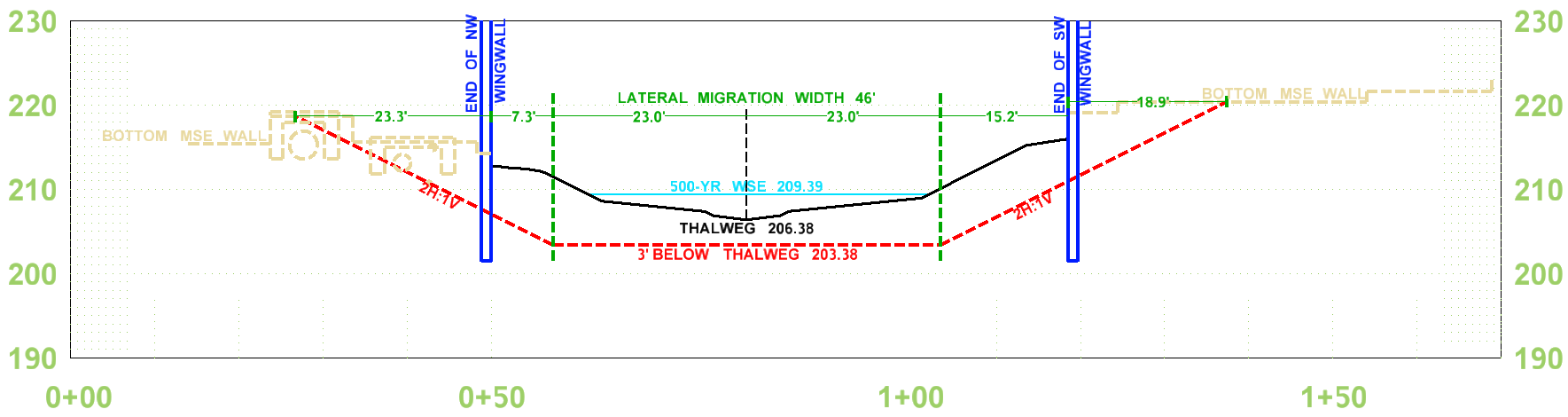
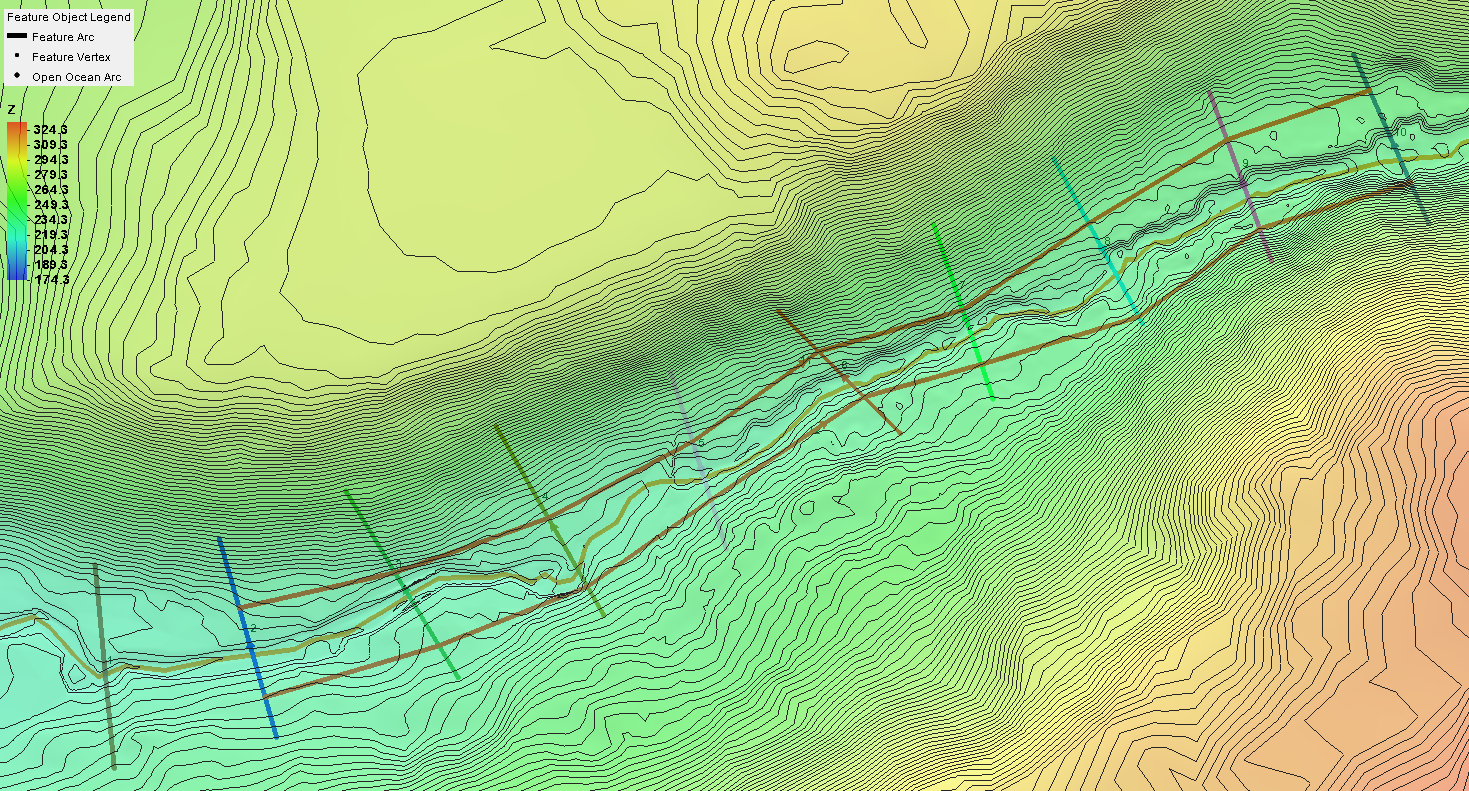
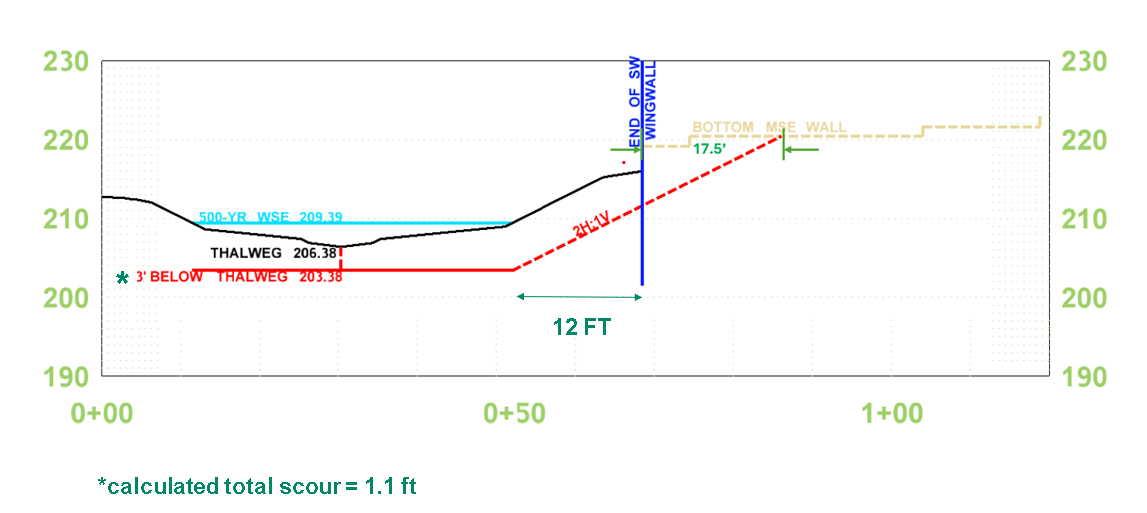
Key conclusions from the full thread:
- No WSDOT rejection of any methodology AECOM proposed.
- Same-day WSDOT approval of 46 ft valley width on June 18, 2025.
- AECOM's own choice to design buried riprap per HEC-23 for MSE wall protection.
- AECOM's own written admission that tunnel and wingwalls were "designed for full scour depth" independent of lateral migration, and that lateral migration was "assumed when conducting scour analysis" as AECOM's own conservative engineering judgment.
- The July 1 TFM #39 language "limits to be determined" was consistent with, not a reversal of, this June 18 exchange.
"WSDOT measured the meander belt width to be 30 feet": Needs verification with Gabe Ng. Did WSDOT measure this, or did WSDOT review AECOM's measurement? The attribution matters.
Admissions against interest (additions to Section VII.C)
From the June 13, 2025 Raheem email:
- "In response to a structural comment from Jason Pang" -- AECOM explicitly says the lateral migration quantification was triggered by Pang's structural comment about the MSE wall, not by any lateral migration classification change. This is standard structural review (TR 2.13.4 / BDM 8.1.10), not direction to change the lateral migration classification.
- "lateral migration was assumed when conducting scour analysis" -- AECOM's conservative assumption, their professional judgment. Not WSDOT direction.
- "no non-erodible geologic features or cohesive materials that could limit the extents" -- AECOM's own geotech data confirms what Comment 196 said. Erodible conditions exist. The reviewer summarized what AECOM's data showed.
- "both tunnel and wingwalls are designed for full scour depth" -- Already designed this way BEFORE this email. Undercuts LTR 384 Section 8's claim that the tunnel was additionally impacted. Aligns with Slide 17 ("did not impact depth of sediment in tunnel").
- "We propose that the modeled 500yr extents be considered" -- AECOM is proposing a methodology to WSDOT, not the other way around. WSDOT did not direct the 500-year extents approach.
From the AECOM supplemental narrative:
- AECOM point 1: "AECOM's approach was to use Figure 8.1.10-1 which assumes the width of the scour prism is equal to the extents of the check flood." This confirms AECOM's initial design choice was to use Figure 8.1.10-1 (without lateral migration). The subsequent use of Figure 8.1.10-2 followed from AECOM's own analysis finding conditions that warranted it, not from WSDOT direction.
- AECOM point 9: After July 28 comment closure, "AECOM subsequently selected BDM Figure 8.1.10-1 to estimate a scour prism... This utilizes the 500-year extent and arrives at a width of approximately 38 feet." After the "reversal," AECOM went BACK to Figure 8.1.10-1 on its own. The design choices were AECOM's throughout.
Cost updates
- LTR 384 amount: $4,615,622 (reduced from $5,466,392)
- Breakdown: Additional Construction $4,015,454, Buried Riprap $474,624, AECOM Design $125,544
- AECOM's own PCN 153 table: 397 hours, $109,169 (discrepancy of $16,375)
- No explanation for $850,770 reduction from LTR 372 amount
Schedule analysis gap
- GP 1-04.5(2)(d) requires "an analysis of the progress schedule showing the schedule change or disruption."
- Both Skanska and AECOM state: "a fully detailed schedule analysis is underway and will be delivered once complete."
- This requirement is not satisfied. WSDOT's determination should note the gap.
IV. EVIDENCE ANALYSIS
A. RCSR Comment Language Pattern (238 Comments)
Package 8 (FHD, 215 comments in the complete form): Zero direction. Key findings: (1) only 2 comments reference Table 2.30-B at all, both about stream morphology type (P005 issue, not lateral migration), (2) language is overwhelmingly consultative (the 202-comment WSDOT transmittal carries 54 "Please," 52 questions, 28 "Consider/Suggest/Recommend"; the 13 additional comments in the complete backcheck form are Muckleshoot Indian Tribe Fisheries channel and fish-passage review, none directive), (3) Comment 134 (SMB) connects lateral migration to retaining wall total scour (supports BDM 8.1.10 distinction).
Package 9 (Structures, 23 comments): Zero direction. Key findings: (1) no Table 2.30-B references at all, (2) four comments cite BDM sections (Comments 3, 4 = BDM 8.1.10; Comment 8 = BDM 8.1.11.C; Comment 13 = BDM 8.1.5D) showing systematic BDM application, (3) Comment 2 (Preference) suggests design alternative that would have avoided the scour concern.
B. Correspondence Thread Summary
Seven letters analyzed:
SL 9727-155 (Sep 12, 2025): WSDOT directed Contract-compliant Juanita Creek design conforming to stream simulation. This is the P005 triggering event. Addresses stream simulation, not lateral migration.
LTR 241 (Sep 29, 2025): Skanska responded that "strict adherence to the directive...is not feasible." Collaborative tone. Attached AECOM notice of protest cites contradictory requirements and ROW impossibility. P005 scope.
LTR 249 + AECOM Supplement (Oct 10, 2025): Most information-dense document. AECOM provides formal Section 1-04.5 supplement with meeting concurrence claims, WDFW positions, ROW constraints. Requests withdrawal of SL-155, additional ROW, or OIC. All P005 scope, but the OIC request pattern is relevant to DRB preparation.
SL 9727-179 (Oct 13, 2025): WSDOT acknowledged LTR 241/249 as Protest 005. Noted meeting minutes not provided within 5-day contractual requirement (Section 2.1.2.2.1).
SL 9727-205 (Nov 25, 2025): WSDOT denied P005. Directed Section 1-04.5(1) dispute procedure. Consistent with P019 denial posture.
SL 9727-233 (Jan 5, 2026): ROW acquisition is Design-Builder's responsibility per Section 2.24. Rebuts AECOM's ROW impossibility argument.
LTR 337 (Jan 30, 2026): Filed 66 days after P005 denial. Different claim (lateral migration RCSR vs. stream simulation) on the same structure. Now evolved into Protest 019 via LTR 372.
C. P005 Intersection
Why P005 matters: Same physical structure (Juanita Creek FP5), same correspondence chain, same designer (AECOM), same RCSR process. Skanska's DRB strategy will likely try to conflate them into "WSDOT kept changing requirements for Juanita Creek."
Scope boundary: LTR337/P019 scope = RCSR Comment 196, BDM 8.1.10 vs. Table 2.30-B, Package 9 Comments 3/4, $5.4M OIC, timeliness. P005 scope = stream simulation methodology, slope ratios, WDFW position, ROW feasibility.
BDM 8.1.10 is confirmed as P019-only. Not mentioned in any P005 correspondence.
DRB conflation risk: If Skanska tries to merge P005 and P019 at DRB, respond with: different contract provisions, different triggering events, different procedural postures. The "reversal" pattern breaks down: in P019 there was no reversal.
D. AECOM Presentation (Slides 16-17)
AECOM Sediment Depth Discussion Presentation, January 16, 2026. Attached to LTR 337.
What helps WSDOT:
Slide 4: AECOM acknowledged Table 2.30-B "low" designation and excluded lateral migration from sediment sizing. Consistent with our position.
Slides 16-17 (Skanska email Q&A): Skanska asked "Why was lateral migration included here? We fought so hard to not include lateral migration at the Sammamish River but seemed to accept it here." Shows Skanska was surprised. Inconsistent with claiming WSDOT "directed" inclusion.
AECOM response: "The final design of the wingwalls and headwall was completed before we received guidance to ignore lateral migration." Design preceded any guidance. AECOM's original professional judgment.
Slide 6 (Figure 7-6): AECOM's own FHD diagram shows "Stream Migration" labeled. AECOM's own engineering work incorporating lateral migration effects.
Tunnel depth not affected. AECOM confirms lateral migration "did not impact depth of sediment in tunnel." Narrows scope.
"Guidance to ignore lateral migration" (DRB talking point). AECOM says their FHD was from "before we received guidance to ignore lateral migration" (Slide 16). The next bullet notes "Sonia closed RCSR comments on lateral migration on July 28, 2025." These are two separate facts, not one event. Sonia (a WSDOT team member who administered comment closure) confirmed the contract designation ("low" per Table 2.30-B, file a DBIC if you disagree). She would not have said "ignore lateral migration." The "guidance to ignore lateral migration" most likely came from Skanska to AECOM. Skanska's own question on the same slide confirms their posture: "We fought so hard to not include lateral migration at the Sammamish River but seemed to accept it here." Skanska was pushing against lateral migration inclusion and likely directed AECOM to follow the contract "low" designation. AECOM's design incorporating lateral migration was their independent professional judgment, completed before Skanska told them to stop. Reserve for DRB. Do not deploy at determination stage. At DRB, if Skanska identifies the "guidance" source, respond accordingly. If they don't clarify, do not volunteer an interpretation. The core point stands under any reading: AECOM designed for lateral migration based on their own analysis before receiving any guidance on the topic. Update April 14, 2026: Gabe Ng's April 14, 2026 email and the complete June 13 - July 25, 2025 thread Gabe provided contain no statement that could be characterized as "guidance to ignore lateral migration." Gabe never directed AECOM to ignore lateral migration. The Design-Builder's burden at DRB to identify the source of the claimed "guidance" is unchanged.
What helps Skanska:
- Design impact was real. Wingwall, headwall, and buried riprap all affected. The $5.4M figure may be supported by actual design differences.
- BDM figures comparison (Slide 14) visually shows the design difference.
- "Significant effort would have been required to redesign." Supports "costs committed" argument.
- Comment resolution as condition of RFC.
E. FHD and Appendix O Findings
Source: AECOM Draft Final Hydraulic Design Report, Juanita Creek at I-405 MP 21.94 (BY-CRE-01827, Package 8, submitted January 28, 2025). Reviewed by WSDOT GNg and HQH, review dated February 18, 2025, RCSR comments returned February 19, 2025.
Section 7.1 (Lateral Migration):
- HEC-20 rapid assessment score = 69 = "good" stream stability
- Vertical instability rating (0.43) slightly dominant over lateral (0.47)
- Risk "low to moderate" (consistent with Table 2.30-B "low" designation)
- Key finding (FHD p.73): "Although the risk for lateral migration is considered low to moderate, the risk in relation to the structure is assumed to occur for the purposes of scour analysis and estimation of total scour. The geotechnical data available at this time are not sufficient to exclude the risk of lateral migration from the scour analysis until detailed geotechnical data (i.e., competent bedrock, geotechnical evaluation for soil erodibility, stream power versus soil erodibility, etc.) is available to support the assessment of no lateral migration being anticipated over the life (75+ years) of the proposed structure."
- This was AECOM's independent professional judgment. The FHD acknowledges the risk is "low to moderate" but chose to include lateral migration because the geotech data was insufficient to exclude it. This decision preceded WSDOT Comment 196.
Section 7.5 (Total Scour) and Table 7-4 (Scour Analysis Summary):
| Component | Scour Design Flood | Scour Check Flood |
|---|---|---|
| Long-term degradation (ft) | 0.12 | 0.12 |
| HEC-18 contraction scour (ft) | 0 | 0 |
| NCHRP 24-20 contraction and abutment scour (ft) | 0.53 | 1.04 |
| Total depth of scour (ft) | 0.65 | 1.16 |
| WSDOT minimum scour depth (ft) | 3 | 3 |
The calculated total scour (0.65-1.16 ft) is far below the 3 ft WSDOT minimum. The minimum governs per WSDOT Hydraulics Manual. The 1.04 ft scour check flood depth "is applied below the channel thalweg and horizontally to the structure walls due to the risk of lateral migration over the lifespan of the proposed structure" (FHD p.81).
Significance for P019: The scour depth delta between "with" and "without" lateral migration is small. The cost driver is NOT deeper scour. The cost driver is the horizontal application of scour to the wingwalls (BDM 8.1.10 Figure 8.1.10-2 treatment), which requires the soldier pile walls to resist lateral erosion of the soil supporting them. This drives embedment depths (14-19 ft per structural calcs) and tieback anchors.
Structural plan progression confirms this (verified 2026-07-06 against the full submittal record). A version-by-version comparison of the East and West portal wingwall plans across the preliminary, final, and Released for Construction submittals shows that scour does not govern the wingwall foundation depth. On the East Portal the preliminary plans carried the deep soldier-pile foundation, embedded 17 to 19 feet, before any bottom-of-scour line was drawn. The preliminary elevation sheet shows no scour line at all. The final plans first added the explicit bottom-of-scour line, at EL 214.23, and set the bottom of the wall fascia 2 feet below it, at EL 212.23, meeting BDM 8.1.10. The three piles nearest the headwall (WW3-01, WW3-02, WW3-03) deepened from 19 to 24 feet of embedment at that final submittal, and two WW4 end piles deepened from 14 to 15 feet with one WW4 pile deleted. That change cannot be a scour response: it coincided with an increase in the wingwall design height (WW3-01 grew from 36'-3" to 37'-5") and the headwall top (EL 249.28 to EL 251.11), and at the Released for Construction stage the bottom of scour was raised about 10 feet, to EL 224.25, with no change to any pile. Retained height and global stability are the driver, not scour. On the West Portal the embedment held at 25 to 26.5 feet across all three versions, pile-for-pile identical in the final and Released for Construction sets, and the bottom of fascia held at EL 201.63, even though the bottom-of-scour elevation was raised approximately 7 feet between the final and RFC plans, from EL 203.63 to EL 210.81. Scour moved 7 to 10 feet and the foundation did not. The explicit bottom-of-scour label and the 2-foot dimension were first annotated at the final submittal, but the deep soldier-pile foundation set well below the wall was already drawn in the preliminary plans on the basis of the Design-Builder's own June 2024 hydraulic design. The foundation did not deepen in response to any review comment, and the East Portal final RCSR records no change to pile embedment. Lateral migration drove the horizontal scour application, not the foundation depth, and is therefore not the cost driver Skanska's claim assumes. Source: full structural submittal record (East BY-CRE-02210 / 03543 / 04325, West BY-CRE-02327 / 03550 / 04750), retrieved from the R2 mirror and verified 2026-07-06.
Section 8 (Scour Countermeasures): "No countermeasures are recommended to protect the abutments from scour at the Juanita Creek crossing of I-405." The FHD did not recommend scour countermeasures at the structure itself. (Buried riprap is a separate downstream countermeasure, addressed under SKA-0297.)
Table 9-1 (Report Summary): Confirms "Lateral migration: No" under floodplain continuity and "Scour countermeasures: No."
Appendix O (Lateral Migration Rapid Assessment):
- Indicator 8 (Bank soil): "Gray silty sand" -- rated Fair (8) = erodible soils
- Field notes: "Bank erosion was encountered in various locations along Juanita...lateral scour further downstream into a resident yard"
- Indicator 1 (Watershed): "36% impervious" -- rated Fair (9) = urbanized watershed
These findings (from the Design-Builder's own technical work) support "NOT low" conditions at the site. The reviewer summarized what AECOM's analysis showed. AECOM reached its engineering conclusion independently, then WSDOT Comment 196 pointed out that AECOM's own findings contradicted a pure "low" treatment.
F. Task Force Minutes Before the Preliminary Report, and the Par Creek Precedent
Verified 2026-08-11 against Fish Passage Task Force minutes #1 through #16, pulled from the Z: mirror at refdocs/zdrive/14 Miscellaneous/14.04 Meeting Minutes/14.04.04 Fish Passage/.
The negative finding. Meetings #1 (October 10, 2023) through #14 (June 4, 2024) are every Fish Passage Task Force meeting held before the Juanita Creek Preliminary Hydraulic Design Report of July 8, 2024. There is a six-week gap between #14 and #15 (July 16, 2024), so #14 is the last meeting before the report. The phrase "lateral migration" does not appear in any of them. Nothing in the Task Force record discusses lateral migration at Juanita Creek, or what must be assumed about it, before the Design-Builder submitted the assumption.
Four near-misses were run down. None is a Juanita lateral migration discussion:
| Meeting | Text found | What it is |
|---|---|---|
| #6, Feb 13, 2024 | "Low risk of lateral migration" | A bullet in a landscaping discussion of live stakes and riparian planting mix |
| #10, Apr 16, 2024 | WSDOT Comment 27 (below) | Package 1B, Par Creek. Not Juanita |
| #13, May 21, 2024 | "meander" x6 | Item 3.12, meander bar spacing and pool-riffle sequence for Stream 25L, Queensborough and North Fork Perry. Channel geometry, not migration risk. Juanita not included |
| #14, Jun 4, 2024 | "meander" x6 | The same item carried forward |
Meeting #10 and Comment 27. Under the agenda item "Final Design Package 1B Comment Responses," the minutes record a WSDOT comment:
"Comment 27: Migration is said to be low, but is not said to be zero. Please clarify what is the anticipated scour envelop based on the scour depth, angle of repose, and lateral migration. It is not clear in the report on the approach. See BDM figure 7.1.7-1 for discussion."
That is the Protest 019 question, asked three months before the Juanita preliminary report. It is not about Juanita. The comment set references BR 522/30W-S, Package 1B is Segment 2, and Par Creek is SR 522 MP 11.26. Juanita Creek is I-405 MP 21.94 in Package 8. Juanita appears at that meeting only under a separate item, "Juanita Creek fine bands," which is streambed gradation and belongs to Protest 021.
The Par Creek precedent, which matters more than the negative. The Par Creek Preliminary Hydraulic Design Report, plans dated November 3, 2023, Section 7.1:
"Although lateral migration has been identified as low risk, at this time there is no detailed geotechnical data (i.e., competent bedrock, geotechnical evaluation for soil erodibility, stream power vs. soil erodibility, etc.) available to support the assessment of no lateral migration being anticipated over the life (75+ years) of the proposed structure. Therefore, lateral migration is expected to occur for the purpose of scour analysis and estimating total scour at the main structure."
Same contract, same Design-Builder, same hydraulic designer, same Table 2.30-B "low" classification, and the same formulation the Juanita report carries eight months later. It also predates WSDOT's April 2024 Comment 27 by five months.
The sequence is therefore identical at both crossings: the designer writes the assume-migration-for-scour sentence, and WSDOT comments afterward. The assumption is not a Juanita-specific judgment that a WSDOT comment could have prompted. It is the designer's standard treatment on this Contract, in use since November 2023.
Anticipated counter. Skanska may cite Comment 27 to argue WSDOT put the program on notice in April 2024 that it expected lateral migration in the scour envelope even where the classification is "low," making the Juanita assumption responsive to WSDOT rather than independent. The answer is the November 2023 date on the Par Creek report. The Design-Builder wrote the sentence five months before that comment. WSDOT's comment followed the practice. It did not create it.
Full Par Creek analysis, including the preliminary-to-final comparison showing the migration allowance was reduced rather than increased, is at analysis/research/Par_Creek_Migration_Precedent.md (verified 2026-07-06). Do not overreach on site physics: Par Creek is ditch-like, low-gradient and heavily backwatered, which Juanita is not. Use it for methodology and internal consistency, not for channel behaviour.
V. GAPS IN SKANSKA'S SUBMITTAL
A. Mischaracterizes the RCSR Comments
LTR 337 and LTR 372 claim WSDOT "directed" NOT low treatment. The actual Comment 196 text shows DJS was summarizing AECOM's findings and gave discretion to disagree. The Design-Builder's characterization is inaccurate.
B. Does Not Acknowledge Their Own Findings
The FHD and Appendix O found erodible soils, beaver activity, and unknown historical channel changes. These findings support "NOT low" conditions. The Design-Builder cannot claim designing for conditions their own analysis identified is extra work.
C. No Distinction Between Requirements
LTR 337 and LTR 372 conflate fish passage lateral migration (Table 2.30-B) with wingwall scour (BDM 8.1.10). Comment 41 explicitly connects to "retaining wall designs." These are separate requirements.
D. No Timely Protest of RCSR Comments
FHD comments issued approximately February 2025. Design-Builder proceeded through RFC (December 2025) without formal objection. Approximately 10-11 months. GP 1-04.5 required timely protest.
E. No DBIC Request
If the Design-Builder sought to change the design approach, GP 1-04.4(2) was the appropriate mechanism. No DBIC submitted. The July 28, 2025 comment closure explicitly told the DB to file a DBIC if it disagreed.
F. No Schedule Analysis
LTR 337 did not include schedule impact analysis. LTR 384 (supplemental) still does not provide one. Both Skanska and AECOM state a "fully detailed schedule analysis is underway." GP 1-04.5(2)(d) requires "an analysis of the progress schedule showing the schedule change or disruption." The supplemental claims "up to 6 months" delay and "likely to affect the Critical Path" but provides no CPM analysis or supporting documentation. This requirement remains unsatisfied.
VI. ENTITLEMENT ANALYSIS
A. Change Claim
WSDOT did not authorize or require a change under GP 1-04.4(1). The RCSR comments were design review, not direction. Section 1-02.1 shields all WSDOT comments on Design Documents from amending contract requirements. Section 1-03.5 bars IED-based entitlement.
Finding: Does not constitute a change. No OIC is warranted.
B. Cost (Updated: $4,615,622 per LTR 384)
Cost history: LTR 337 claimed $5,466,392. LTR 384 reduced this to $4,615,622, a decrease of $850,770 with no explanation for the reduction.
LTR 384 breakdown:
| Item | LTR 384 Amount | WSDOT Assessment | Attributable to WSDOT Direction? |
|---|---|---|---|
| Additional Construction (Wingwalls, Headwalls, Tunnel) | $4,015,454 | No line-item backup provided. Actual scour is 0.65-1.16 ft (3 ft minimum governs). Embedment depth (14-19 ft) driven by retained height (31-42 ft) and soil conditions. Lateral migration drives horizontal application (BDM Figure 8.1.10-2), not vertical depth. AECOM's own FHD found conditions supporting inclusion. AECOM's June 13, 2025 email: "both tunnel and wingwalls are designed for full scour depth" before any methodology was accepted. | NO |
| Buried Riprap Countermeasures | $474,624 | Section 2.30.5.6 requires DB to design scour countermeasures. FHD Section 8: "No countermeasures are recommended to protect the abutments from scour." Buried riprap protects the existing MSE wall downstream. AECOM's June 13 email confirms riprap was triggered by Jason Pang's structural comment on the MSE wall (TR 2.13.4 obligation). TFM #38: "Design builder proposing buried rip-rap for scour protection" -- DB proposed it. | RESERVED (SKA-0297) |
| Design Costs (AECOM) | $125,544 | AECOM's own PCN 153 table shows 397 hours / $109,169. Discrepancy of $16,375. Skanska's figure is unsupported by AECOM's own documentation. | NO |
| Total | $4,615,622 |
Prior LTR 337 breakdown (for reference):
| Item | LTR 337 Amount |
|---|---|
| Additional structural elements | $4,015,454 |
| Additional shoring elements | $815,892 |
| Buried riprap countermeasures | $474,624 |
| Design costs | $160,423 |
| Total | $5,466,392 |
Delta analysis: The $850,770 reduction appears to come primarily from removing "additional shoring elements" ($815,892) and reducing design costs ($160,423 to $125,544). The construction and buried riprap amounts are unchanged. The removal of shoring elements with no explanation weakens the certainty of the original claim.
The attribution problem: Skanska assumes all lateral migration-related design is attributable to WSDOT direction. The evidence shows AECOM's original design included lateral migration before any WSDOT comment. AECOM's analysis found supporting conditions. BDM 8.1.10 independently required total scour evaluation. Section 2.30.5.6 required scour analysis.
Scour depth reality check: Skanska's framing suggests lateral migration dramatically increased scour. The FHD shows total scour is 0.65-1.16 ft, governed by the 3 ft WSDOT minimum regardless. The cost driver is horizontal application to wingwalls (BDM 8.1.10 Figure 8.1.10-2), not deeper scour. Further, the wingwall retained heights (31-42 ft) are driven primarily by the tunnel excavation depth, not scour. The incremental cost of lateral migration treatment on walls that already need to be 31-42 ft tall for other reasons is far less than $5.4M. Engineering review should quantify this.
Cost attribution (qualitative, reserved for DRB): Even setting aside the entitlement question, much of the $5.4M cost was driven by the Design-Builder's own wingwall configuration choice. Package 9 Comment 2 (HQH, "Preference") suggested angled wingwalls at 25-45 degrees off the headwall. WSDOT's suggestion would have reduced wall length, wall depth, embedment depth, soldier pile count, tieback anchor rows, scour exposure, and buried riprap need. It would also have stayed on existing ROW (avoiding the SKA-0297 property rights problem entirely). The Design-Builder chose parallel wingwalls instead. The parallel configuration drove the cost magnitude. This is a design choice defense. It does not argue whether lateral migration analysis was required. It argues that the cost magnitude was driven by the DB's configuration, not by WSDOT comments. Quantitative analysis requires independent estimate (future phase).
Finding: Not entitled to cost adjustment. Costs result from AECOM's professional analysis and mandatory standard compliance, not WSDOT direction.
C. Schedule
No schedule analysis provided per GP 1-04.5(2)(d). WSDOT reserves the right to contest any schedule claim raised in the supplemental.
Finding: Not entitled to time extension based on current submittal.
D. Buried Riprap (Reserved for SKA-0297)
The buried riprap countermeasures are unique: they protect the "existing MSE wall downstream of the structure" (not the new fish passage structure). The countermeasure obligation derives from Section 2.30.5.6. Property rights for the riprap footprint are at issue under SKA-0297 (SL 9727-233).
P019 determination should acknowledge the buried riprap claim but defer to SKA-0297 for resolution.
VII. DRB PREPARATION
A. Defense Layering
Three defense lines, deployed in sequence:
| Layer | Defense | Deployed In | Notes |
|---|---|---|---|
| 1 | RCSR comments were design review with discretion (Comment 196) | SL 9727-280 (determination) | Primary defense |
| 2 | Section 2.30.5.6 required the scour analysis (contractual obligation) | SL 9727-280 (determination) | Secondary defense |
| 3 | BDM 8.1.10 requires total scour for retaining walls (existing Mandatory Standard) | Reserved for DRB | Requires engineering support |
Why BDM 8.1.10 is reserved for DRB:
- Section 2.30.5.6 carries the contractual obligation defense sufficiently for a determination letter.
- BDM opens technical arguments (Does 8.1.10 apply to fish passage wingwalls? Does "low" mean Figure 8.1.10-1? Is there a conflict?) that require engineering testimony.
- Deploying BDM at DRB as a third defense line, with engineering support, is stronger than deploying it in a letter without technical backing.
Considered but not relied upon: Section 2.30.5.2.1 Scour Provision. This provision resolves conflicts between SFZ dimensions and scour analysis results. WSDOT does not rely on it because: (1) our argument is that there is no conflict between Table 2.30-B and scour requirements, (2) citing a conflict-resolution provision implies a conflict exists, and (3) we have not confirmed whether wingwall foundations actually encroach below the CBE or beyond the SFZ Width. If raised at DRB, respond: "The scour provision addresses conflicts between SFZ dimensions and scour requirements. It is not relevant here because WSDOT's position is that there is no conflict."
B. Strengths and Weaknesses
WSDOT strengths:
- Comment 196 text is unambiguous: "seems like," "please revise" = discretion
- Section 1-02.1 shield is textually absolute for comments
- Section 1-03.5 entitlement bar and burden-shifting favor WSDOT
- AECOM's own analysis found conditions supporting the design
- AECOM's design preceded any guidance on lateral migration
- 238 comments across the complete RCSR forms, zero directive language
- July 28, 2025 comment closure confirmed "low" and directed DBIC if disagreed
- DB proceeded 10-11 months without protest
Skanska strengths:
- Design impact was real. $5.4M may be supported by actual design differences.
- BDM figures comparison makes the scope argument tangible.
- "Significant effort to redesign" supports costs committed.
- RCSR resolution was a practical prerequisite for RFC.
C. Admissions Against Interest
Statements by Skanska/AECOM that undermine their position:
- Skanska email: "Why was lateral migration included here? We fought so hard to not include lateral migration at the Sammamish River but seemed to accept it here." -- Shows Skanska considered the decision to be AECOM's.
- AECOM Slide 4: Acknowledged Table 2.30-B "low" and excluded lateral migration from sediment sizing. They knew the contract said "low."
- AECOM Slide 16: "Design completed before we received guidance to ignore lateral migration." -- Design preceded guidance.
- AECOM Slide 17: Tunnel depth "not affected" by lateral migration. -- Narrows scope.
- LTR 337 filing 66 days after P005 denial. Alternative cost recovery inference.
- Skanska's framing question (Slide 17): "Would like AECOM to review the attached and included information and depict in AECOM's opinion how WSDOT influenced the design here on the lateral migration front." Shows Skanska directing AECOM to build the "WSDOT influenced" narrative. AECOM's response is more measured: design "may have been different if received guidance on lateral migration sooner." AECOM did not say WSDOT directed the design.
- Slide 16 identifies the "guidance" source: Two separate facts on Slide 16: (1) AECOM received "guidance to ignore lateral migration" and (2) Sonia closed RCSR comments July 28, 2025. These are not the same event. The "guidance" most likely came from Skanska to AECOM, directing compliance with the contract "low" designation. Sonia's closure was administrative confirmation. See Section IV.D item 6.
D. P003 Coordination
P003 status: DRB (Notice of Dispute filed LTR 348, February 12, 2026). Same DRB panel may hear both.
Alignment rules:
- Do not argue Table 2.30-B is "merely informational." WSDOT relied on it in P003.
- Do not argue engineering analysis can override contract designations. That is Skanska's P003 argument.
- Consistent position: Table 2.30-B designations stand as written. WSDOT enforces them. RCSR review is separate from contract enforcement.
RCSR characterization caution: The P003 memo characterizes an RCSR comment as the "First written WSDOT position." P019 calls RCSR comments "design review, not direction." These are reconcilable:
- At Sammamish (P003): the RCSR reinforced an explicit contract mandate (Section 2.30.5.2.1 "shall apply").
- At Juanita (P019): the RCSR identified an internal inconsistency in the designer's work.
Do NOT make blanket statements that RCSR comments can never constitute a WSDOT position. Characterize each comment on its own terms. The unifying principle: contract requirements are the floor.
E. Engineering Review Items
Items from AECOM presentation requiring engineering verification:
| # | Item | Source | Question | Priority |
|---|---|---|---|---|
| 1 | AECOM scour values | FHD Table 7-4 | RESOLVED. Total scour = 0.65 ft (design flood) to 1.16 ft (check flood). WSDOT 3 ft minimum governs. LTD = 0.12 ft. Contraction scour = 0. Abutment scour = 0.53 ft (design) to 1.04 ft (check). The scour depth delta from lateral migration is effectively zero at the structure because the 3 ft minimum governs regardless. The cost driver is horizontal application to wingwalls (BDM 8.1.10), not deeper scour. See Section IV.E. | RESOLVED |
| 2 | "Guidance to ignore lateral migration" | Slide 16 | RESOLVED (RESERVED FOR DRB). Source identified. Slide 16 has two separate facts: (1) AECOM designed "before we received guidance to ignore lateral migration" and (2) "Sonia closed RCSR comments on lateral migration on July 28, 2025." These are not the same event. Sonia administered comment closure confirming the contract "low" designation. She would not have said "ignore lateral migration." The "guidance" most likely came from Skanska to AECOM, directing AECOM to follow the contract "low" designation. Skanska's own question confirms: "We fought so hard to not include lateral migration." AECOM designed for LM based on own professional judgment, then Skanska told them to stop. Do not deploy at determination stage. At DRB, respond to the source if Skanska identifies it. Do not volunteer an interpretation. See Section IV.D item 6 for full analysis. | RESOLVED (RESERVED FOR DRB) |
| 3 | RCSR comment closure (July 28, 2025) | Slide 16 | What does "closed" mean? Reviewer accepted response, or AECOM resolved? | MEDIUM |
| 4 | Wingwall depth "up to 15 feet" | LTR 337 Section 3(c) | RESOLVED. Structural calcs (AECOM, Feb 24, 2025) confirm: WW3 retained heights 18'-36' (12 piles, embedment 17-19 ft). WW4 retained heights 10'-34' (10 piles, embedment 14-19 ft). Soldier piles W21x101 and W24x104 with 1-3 rows of permanent tieback anchors. "Up to 15 feet" likely refers to embedment depth increment, not total wall height. Total retained heights (31-42 ft max) are driven by tunnel excavation depth, not scour. The 14-19 ft embedment is driven by soil conditions and retained height, with lateral migration treatment affecting the horizontal scour assumption but not directly adding 15 ft. FPS-02 Note 4: "designed for scour in accordance with the hydraulic report dated June 2024." | RESOLVED |
| 5 | MSE wall classification | Slides 18-19 | RESOLVED. Wall 2185L-A is an existing MSE wall. RFP Section 2.6 (Seismic Design Requirements for Existing Retaining Walls): "The existing MSE Wall, Wall 2185L-A at the Juanita Creek Culvert will require full or partial replacement to install the fish passage structure. Within a minimum lateral distance of 100 feet from the outer edges of this culvert structure, any remaining parts of existing wall 2185L-A shall meet all design requirements of this Contract, including seismic design." Also listed in Section 2.6 pre/post-construction survey requirements. The contract anticipated the MSE wall would be affected by the fish passage work. Section 2.13.4 requires existing wall elements "affected by the Work" to "meet the minimum foundation cover requirements or be protected against scour to that level." This supports WSDOT's position that scour protection for the existing MSE wall is a contract obligation, not additional scope. Relevant to SKA-0297 buried riprap analysis. | RESOLVED |
| 6 | Design alternatives and cost allocation | Slide 17, Comment 2 (Pkg 9) | PARTIALLY RESOLVED (qualitative). Package 9 Comment 2 (HQH, "Preference") suggested angled wingwalls (25-45 degrees) instead of parallel. DB chose parallel. Qualitative savings categories from angled wingwalls: (1) shorter wall length, (2) reduced retained height, (3) less embedment depth, (4) fewer tieback anchor rows, (5) fewer soldier piles, (6) no ROW encroachment (avoids SKA-0297), (7) less scour exposure per BDM 8.1.10, (8) less buried riprap. The parallel wingwall orientation (DB's choice) drove the depth/cost problem ($5.4M claim), the property rights problem (SKA-0297), and the scour exposure problem. This is a design choice cost attribution defense. Reserve for DRB. Quantitative analysis requires independent estimate (future phase). | HIGH |
| 7 | Wingwall depth vs. riprap trade-off | Slide 17 | Reducing wingwall depth increases buried riprap. Optimal balance? | LOW |
VIII. DISPOSITION OF REQUESTS (R1-R4)
| ID | Request | Disposition | Rationale |
|---|---|---|---|
| LTR372-R1 | Reconsider and withdraw SL 9727-280 | DENIED | SL 9727-280 correctly interprets contract requirements. RCSR comments were design review. IED is properly issued under GP 1-03.5. |
| LTR372-R2 | Process OIC for $5,466,392 | DENIED | No OIC warranted. RCSR review is not direction. GP 1-03.5 bars IED-based entitlement. DB bears burden of proving interpretation incorrect or unreasonable. |
| LTR372-R3 | Direction on buried riprap countermeasures | RESERVED | Addressed in WSDOT's response to SKA-0297 (Juanita Creek Property Rights). |
| LTR372-R4 | 14 calendar day extension for supplemental | DENIED | Extension denied. Standard GP 1-04.5 deadline applies. Supplemental due March 24, 2026 (14 calendar days from March 10, 2026). |
Reservation of rights: Skanska reserves all rights including DRB referral under GP 1-04.5(1).1. Noted.
AECOM protest: AECOM notice of protest (Jon Guerrero, PE, March 9, 2026, PCN-00153). AECOM is a subcontractor to Skanska. AECOM's protest is processed through the Design-Builder per the contract. WSDOT does not have a direct contractual relationship with AECOM. Noted.
IX. KEY CONTRACT REFERENCES
| Section | Purpose |
|---|---|
| GP 1-02.1 | WSDOT comment shield. "No comments... shall be deemed, construed, or interpreted to amend, supersede, or alter." |
| GP 1-03.5 | IED authority. Entitlement bar. Burden-shifting. |
| Table 2.30-B | Fish passage lateral migration classification ("low" at Juanita Creek) |
| Section 2.30.5.2.1 | Table 2.30-B compliance and precedence clause |
| Section 2.30.5.6 | Scour analysis requirements. DB "shall perform a scour analysis" including LM risk. "Shall locate, design and construct any required scour countermeasures." |
| BDM Section 8.1.10 | Retaining wall scour requirements. Total Scour includes lateral migration effects. Reserved for DRB. |
| Section 2.13.4 | BDM as Mandatory Standard for scour |
| GP 1-04.4(1) | OIC requires WSDOT directive |
| GP 1-04.4(2) | DBIC mechanism (DB never submitted one) |
| GP 1-04.5 | Protest procedure. 14-day window. Supplemental and determination timeline. |
| GP 1-04.1 | Contract Price includes compliance costs |
X. DISPUTE NOTICE (LTR 417) PROCEDURAL POSTURE
This section captures the post-determination analysis supporting the dispute acknowledgment letter. Skanska LTR 417 was filed April 28, 2026 (Day 14 of the dispute window after WSDOT SL 9727-326 transmitted April 14, 2026). AECOM's separate Notice of Dispute dated April 24, 2026 is attached as a sub-tier internal communication adopted via GP 1-05.15. See Response Matrix LTR417 layer for assertion-level dispositions.
X.A. Two-Gate DRB Qualification Verdict
Gate 1 (Subject-Matter Eligibility) under GP 1-04.5(1).1.2: OPEN. The dispute concerns interpretation of the Contract (Table 2.30-B classification, Section 1-02.1 comment shield, Section 1-03.5 IED authority, BDM 8.1.10 Mandatory Standard) and entitlement to additional compensation and time. Both eligibility categories satisfied.
Gate 2 (Procedural Conditions Precedent) under GP 1-04.5 + GP 1-04.5(1): OPEN. Every contractual timing window was met (most on the last day):
| Step | Required | Skanska Action | Compliant |
|---|---|---|---|
| Notice of Protest within 14 calendar days of WSDOT Written Determination | Mar 10, 2026 | Skanska LTR 372 filed Mar 10, 2026 | Yes (Day 14) |
| Supplemental within 14 calendar days of protest | Mar 24, 2026 | Skanska LTR 384 filed Mar 24, 2026 | Yes (Day 14) |
| WSDOT no-merit determination within 21 calendar days of supplemental | Apr 14, 2026 | WSDOT SL 9727-326 transmitted Apr 14, 2026 | Yes (Day 21) |
| Notice of Dispute within 14 calendar days of receipt of no-merit determination | Apr 28, 2026 | Skanska LTR 417 filed Apr 28, 2026 | Yes (Day 14) |
| Election to use DRB | Required | Skanska LTR 417 expressly requests DRB | Yes |
Verdict: WSDOT cannot procedurally bar referral to the Disputes Review Board. Asserting otherwise would itself be a procedural defect on the WSDOT side.
X.B. Procedural Limiters That Survive Into the Hearing
WSDOT's acknowledgment letter will document two procedural limiters. Both are scope, quantum, and entitlement constraints operating at the hearing rather than referral bars.
Limiter B (Schedule analysis record gap): GP 1-04.5(2)(d) required the supplemental Written Statement to include an analysis of the progress schedule showing the schedule change or disruption. Skanska LTR 384 did not include this analysis. Skanska LTR 417 does not include this analysis. Skanska represents that the analysis is underway and will be provided as a future supplement. GP 1-04.5 does not establish a procedure for supplementing a Notice of Dispute. WSDOT noted the gap in WSDOT SL 9727-326 paragraph 8 and proceeded to merits. The framing for the acknowledgment letter is "the schedule entitlement is unsupported on the existing record," not "barred."
Limiter C (Cost elements not in supplemental): GP 1-04.5(2)(b) required the supplemental Written Statement to include a full discussion of the circumstances which caused the protest. Skanska LTR 417 introduces the line items "Stream Re-Alignment" ($79,340) and "Design for Stream Re-Alignment" ($50,183), and an increase in the AECOM design cost from $125,544 to $401,941. None of these elements were in Skanska LTR 384. WSDOT's framing for the acknowledgment letter is "WSDOT understands the dispute to be limited to the circumstances and bases set forth in Skanska LTR 384, the supplemental Written Statement."
Three-stage operationalization. The acknowledgment letter is record preservation. The application of each limiter at the position paper and hearing stages is operationally distinct.
| Stage | Limiter B (Schedule analysis record gap) | Limiter C (Cost elements not in supplemental) |
|---|---|---|
| Acknowledgment letter | Cite the GP 1-04.5(2)(d) gap. Plain contract language. No "barred" overreach. No reservation of rights. | Cite GP 1-04.5(2)(b). Name the Stream Re-Alignment line items and the AECOM design cost growth. State that WSDOT understands the dispute to be limited to the circumstances and bases in Skanska LTR 384. |
| Position paper | Argue schedule entitlement is unsupported on the existing record. Decline to engage on the merits with any post-supplemental CPM analysis filed by the Design-Builder. If the Design-Builder files such an analysis as a position-paper attachment, treat as outside the protest record. | Argue the dispute is limited to circumstances and bases set forth in Skanska LTR 384. Object to introduction of the Stream Re-Alignment cost element and the AECOM design cost growth as new bases for entitlement. |
| Hearing | If the Disputes Review Board allows the schedule analysis in evidence, limit the cost-and-time-impact rebuttal to the value supportable on the original record. | If the Disputes Review Board allows the new cost elements in evidence, focus the rebuttal on the substantive merits. The substantive defenses are in WSDOT SL 9727-326 paragraph 3. The Design-Builder's wingwall scour analysis obligation arises from BDM 8.1.10 as a Mandatory Standard incorporated through TR 2.13.4. The Design-Builder's scour countermeasure design obligation, which is the contractual basis for any Stream Re-Alignment cost element, arises from TR 2.30.5.6 and HEC-23 (Federal Highway Administration Hydraulic Engineering Circular No. 23, listed in TR 2.30 Mandatory Standards and incorporated by reference through BDM 8.1.10). The reviewer cited the controlling standards. The reviewer did not create a new directive. |
X.C. Verified Facts From Comprehensive Document Review (April 29, 2026)
Initial scan of LTR 417 against summary sources flagged four "new at dispute stage" assertions. Comprehensive review against the four corners of LTR 384 plus AECOM PCN-153 produced corrections:
| Item Initially Flagged as New | Verification Against LTR 384 + PCN-153 | Status |
|---|---|---|
| WSDOT had already rejected Figure 8.1.10-1 | LTR 384 Section 6 expressly raises this. PCN-153 item 2 describes the Jan-Feb 2025 discussions on Figure 8.1.10-1 versus Figure 8.1.10-2. | Not new |
| WSDOT directed lateral migration calculations at the Feb 11, 2025 Task Force meeting | LTR 384 / PCN-153 item 2 references Jan-Feb 2025 discussions generally. The specific Feb 11 date is more precise than the supplemental but within the same period. | Date-specific, immaterial |
| WSDOT rejected AECOM's 60-foot valley width analysis | PCN-153 item 4 expressly states the 60-foot valley width was proposed and rejected. | Not new |
| WSDOT's RCSR comments directed use of Figure 8.1.10-2 | LTR 372 Section 2.1 and LTR 384 Section 2 both raise this. | Not new |
| OIC theory under GP 1-04.4(1) (vs. constructive direction) | LTR 384 Requested Relief (b) was already an OIC request under GP 1-04.4(1). Constructive direction was the analytical theory; OIC was the relief mechanism. | Not a theory pivot |
Genuinely new at dispute stage:
- Stream Re-Alignment cost element ($129,523 combined) — scope emerging from AECOM's April 7, 2026 stream-realignment proposal, after the supplemental window closed.
- AECOM design cost growth from $125,544 to $401,941 — no PCN-153 backup for the increase. PCN-153 documented 397 hours and $109,169.
X.D. Substantive Defense Already in the Determination
The internal-contradiction theory I considered (PCN-153 item 9 admitting the final RFC scour countermeasure used Figure 8.1.10-1 without lateral migration at 38 ft, contradicting LTR 384 Section 8's tunnel claim) does not need to be argued as a procedural limiter. The substantive defense is already in WSDOT SL 9727-326 paragraph 3:
"The 'shall' language in Package 9 structural review Comments 3 and 4 quotes Bridge Design Manual (BDM) Section 8.1.10 verbatim. BDM requirements are existing mandatory standards, not new WSDOT directives. Compliance with mandatory standards is the Design-Builder's responsibility under the Contract Price per GP 1-04.1."
Whether AECOM ultimately built (or builds) the structure under Figure 8.1.10-1 or Figure 8.1.10-2 is the Design-Builder's professional engineering judgment under BDM 8.1.10. The reviewer cited the BDM. The reviewer did not create a new directive. This defense does not need restatement in the acknowledgment letter. It is reserved for the position paper.
X.E. AECOM Pathways at the Disputes Review Board
AECOM's participation at the DRB hearing operates through GP 1-04.5(1).1.8. There is no separate "outside party" mechanism in the Contract, the Three-Party Agreement (Form 134-091, standard), or the F04 DRB Forms and Guidelines (Appendix F4 of the RFP). AECOM has two pathways:
Subcontractor authorized representative. Required and automatic. GP 1-04.5(1).1.8 (Attendance, item 2.e) provides that "At Board hearings regarding disputes involving a Subcontractor, the Design-Builder shall require and ensure that each Subcontractor involved in the dispute have present an authorized representative with actual knowledge of the facts underlying the Subcontractor disputes."
Outside Expert. With proper disclosure. GP 1-04.5(1).1.8 (Use of Outside Experts, item 1.a) requires the Design-Builder to notify WSDOT and the Board in writing no less than 30 calendar days prior to the pre-hearing submittal due date. The notice must include: the expert's name and area of testimony; a Section 1-04.5(1).1.5 item 3(b) disclosure statement; and a statement of qualifying experience and training.
The acknowledgment letter does not need to address AECOM standing. Both pathways self-execute at the hearing-prep stage.
X.F. Cost Trajectory of the Claimed Amount
For internal record only. Reduction of stated quantum across the protest, supplemental, and dispute stages:
| Document | Date | Stated Amount |
|---|---|---|
| Skanska LTR 372 (Notice of Protest) | Mar 10, 2026 | $5,466,392 |
| Skanska LTR 384 (Supplemental) | Mar 24, 2026 | $4,615,622 |
| Skanska LTR 417 (Notice of Dispute) | Apr 28, 2026 | $3,179,809 |
Cumulative reduction from initial claim is 42 percent. Per Zach's drafting principle, quantum is downstream of merit and the number will likely change again. The acknowledgment letter will not address the cost trajectory directly. WSDOT's record position is that the dispute is limited to the circumstances and bases set forth in Skanska LTR 384.
X.G. Action Items
| # | Item | Priority | Success Condition |
|---|---|---|---|
| 1 | Draft dispute acknowledgment letter | HIGH | Markdown draft completed in analysis/. Built to docx via python-docx script following the existing P019 deliverables pattern. Reviewed by Zach. Transmitted to Evelyn for signature. SL number assigned. Filed at OneDrive 9.02 To Skanska. |
| 2 | Position paper preparation | HIGH | Outline drafted. Common Reference Documents (CRDs) assembled. Statement of Dispute and Question drafted. Draft circulated to project staff per Brickyard Protest Dispute and Claims Summary best practices. |
| 3 | Retrieve structural design submittals from Z: drive | MEDIUM | Robocopy commands executed on Remote Desktop. Files synced to OneDrive Brickyard tree under 09727_DataExports/Protest_019_Designs/. Copies linked into protest_019/references/Submittals/ as needed for citation in the position paper. |
| 4 | Compile Common Reference Documents (CRDs) | MEDIUM | Combined index of WSDOT and Design-Builder reference documents prepared in single binder convention. Index circulated to the Design-Builder for review prior to submission to the Disputes Review Board. |
| 5 | Evaluate joint Statement of Dispute and Question(s) with the Design-Builder | MEDIUM | Draft statement sent to the Design-Builder. Either agreement reached on a joint statement or both versions submitted per GP 1-04.5(1).1.8. |
[INTERNAL MEMO -- Protest 019 -- SKA-0303 -- Prepared March 11, 2026 -- Updated April 6, 2026 (LTR 384 supplemental incorporated) -- Updated April 29, 2026 (Section X added: LTR 417 Notice of Dispute procedural posture)]
Sequence of Events and Timeliness of the Request
A second, narrower document set. It addresses one question: when the Design-Builder adopted the lateral migration assumption, and when it first told WSDOT it regarded that work as compensable. The technical merits and the amount claimed are covered by the position paper above and are not addressed here. The set is the summary and the paper that follow, plus the handout.
Executive Session Handout (11x17, PDF)WSDOT Position Paper - Executive Summary
Sequence of Events. Protest 019 - Juanita Creek Fish Passage Lateral Migration. Issue SKA-0303. Contract No. 9727, I-405 Brickyard to SR 527 Improvement Project. Prepared for the executive session of August 14, 2026. Draft for executive review. Not transmitted.
- July 8, 2024. The Design-Builder submitted the Preliminary Hydraulic Design Report assuming lateral migration for the scour analysis.
- July 30, 2024. WSDOT returned comments on that report and raised no comment on lateral migration.
- January 28, 2025. The Final Hydraulic Design Report carried that paragraph word for word.
- February 19, 2025. WSDOT returned 202 comments, its first comment on lateral migration at this crossing.
- June 13, 2025. The Engineer of Record wrote that it had "designed tunnel and wingwalls for full scour depth."
- July 28, 2025. WSDOT stated the Contract classification in writing to the Engineer of Record, copying Skanska.
- September 16 and 17, 2025. Final design of both portals submitted.
- December 24, 2025. East Portal RFC plans transmitted. Piles fabricated.
- January 30, 2026. Skanska LTR 337, the first statement that this work was compensable.
1. The Question
This summary addresses one question. When did the Design-Builder decide to design the Juanita Creek wingwalls for lateral migration, and when did it first tell WSDOT that it regarded that work as a change for which it would seek payment?
The technical merits are set out in WSDOT Serial Letter (SL) No. 9727-280 and WSDOT SL No. 9727-326. The amount claimed is reserved and is not addressed here.
2. WSDOT's Position
A review comment cannot direct a design that already exists. When WSDOT first commented on lateral migration on February 19, 2025, the migration assumption had been carried in the Design-Builder's submitted report since July 8, 2024, and had already passed through a WSDOT review that raised no comment on the subject at all.
The Design-Builder adopted the migration assumption before WSDOT commented on it, carried it unchanged through every submitted hydraulic design report, completed the design of both portals, transmitted the East Portal for construction and had its material fabricated, and only then told WSDOT it regarded the work as compensable. WSDOT was not given the opportunity to evaluate an Owner-Initiated Change while that choice was still open.
3. The Sequence
1. The assumption came first, by seven months. The Preliminary Hydraulic Design Report of July 8, 2024 states that the risk of lateral migration "is assumed to occur for the purposes of scour analysis and estimation of total scour." WSDOT returned comments on that report on July 30, 2024, twenty-two days later, and raised no comment on lateral migration. Section 7.1 of the Final Hydraulic Design Report of January 28, 2025 carries that paragraph word for word. No WSDOT comment created the migration assumption.
2. WSDOT commented promptly on both reports. Twenty-two days after the preliminary report and twenty-two days after the final report. The six months separating the two reports is the time the Design-Builder took to prepare the final one, and the migration assumption was not revisited in it.
3. The comments the Design-Builder relies on came afterward. Comments 196, 39 and 41, returned on February 19, 2025, each responded to a design that already assumed lateral migration. Comment 196 proposed alternative wording and ended by inviting the Design-Builder to revise it "if this is not correct." None of the three created the assumption.
4. The Design-Builder described the assumption as a conservatism it had adopted. On June 13, 2025 its Engineer of Record wrote that "the risk of lateral migration may only be low to moderate; however, to be conservative, lateral migration was assumed when conducting scour analysis," and that "both tunnel and wingwalls are designed for full scour depth."
5. The design was complete before the request. Technical Requirements (TR) 2.28.3.4.3 Final Design Submittal provides that "the Final Design Submittal shall be prepared when the design for a given element or area is complete." The final design of the East Portal was submitted on September 16, 2025 and of the West Portal on September 17, 2025. Neither portal returned for a further final design submittal. The Engineer of Record stated that the wingwall and headwall design was complete before July 2025.
6. Nothing was said until January 2026. The East Portal RFC plans were transmitted on December 24, 2025, and its piles were fabricated. Between July 28, 2025 and January 30, 2026 the submittal register and the project correspondence record contain no request for a change from the Design-Builder. The first statement that this work was compensable came on January 30, 2026.
4. Recommendation
On this record, WSDOT does not consider a referral to the Disputes Review Board to be a productive use of either party's resources, and recommends the parties conclude this matter without referral.
WSDOT Position Paper
Protest 019, Juanita Creek Lateral Migration
Sequence of Events
Contract 9727, I-405 Brickyard to SR 527 Improvement Project
Prepared for the executive session of August 14, 2026
DRAFT for executive review. Not transmitted.
1. Purpose and Scope
This paper sets out one sequence: when the Design-Builder decided to design the Juanita Creek fish passage wingwalls for lateral migration, and when it first told WSDOT that it regarded that work as a change for which it would seek payment.
It takes no position on the technical merits, which are set out in WSDOT Serial Letter (SL) No. 9727-280 dated February 24, 2026 and WSDOT SL No. 9727-326 dated April 14, 2026. The amount claimed is reserved and is not addressed here.
Scour countermeasures for the existing mechanically stabilized earth (MSE) wall downstream of the West Portal are a separate matter and are not addressed here. The June 2025 exchange set out in Section 4 began with a WSDOT comment on that wall. It is reproduced because the Design-Builder used it to state the basis of its tunnel and wingwall design.
2. The Design-Builder Assumed Lateral Migration in Its First Submittal
The Design-Builder submitted the Preliminary Juanita Creek Hydraulic Design Report on July 8, 2024. Section 7.1, at page 63, states:
"Although the risk for lateral migration is considered low to moderate, the risk in relation to the structure is assumed to occur for the purposes of scour analysis and estimation of total scour."
That decision, to assume that lateral migration occurs for the purposes of scour analysis, is called the migration assumption in this paper.
WSDOT returned its review comments on July 30, 2024, twenty-two days later. It raised no comment on lateral migration. Nor was lateral migration at Juanita Creek raised at any Fish Passage Task Force meeting before that date. Meetings 1 through 14, October 10, 2023 through June 4, 2024, are every meeting held before the preliminary report was submitted. The subject appears twice in those minutes and neither instance concerns this crossing. Meeting No. 6 records a planting observation. Meeting No. 10 records a WSDOT review comment on the Package 1B final design at Par Creek.
The Design-Builder submitted the Final Juanita Creek Hydraulic Design Report on January 28, 2025. Section 7.1 of the final report, at page 73, carries that paragraph word for word. Nothing in it changed.
The final geotechnical report for the package had been submitted on November 15, 2024 and returned by WSDOT on December 6, 2024, seven weeks before the final hydraulic report. Section 7.1 still states that the geotechnical data were not sufficient.
3. WSDOT's First Comment on Lateral Migration Came Seven Months Later
WSDOT returned its comments on the final report on February 19, 2025, twenty-two days after receiving it. That is the first time WSDOT commented on lateral migration at Juanita Creek, and it is seven months after the assumption already appeared in the submitted report.
Three of those comments are the ones the Design-Builder now relies on.
Comment 196 proposed alternative wording for the report's summary of migration risk, and ended by inviting the Design-Builder to revise it "if this is not correct."
Comment 39 asked the Design-Builder to establish the outer limits of channel migration.
Comment 41 addressed the basis on which migration had been assessed.
Each of those comments responded to a design that already assumed lateral migration. None of them created it.
Between February and May 2025 the structural design advanced without a request for a change. The East Portal preliminary structures were submitted on March 17, 2025 and returned the same day, resubmitted on March 25 and dispositioned in April. The West Portal preliminary structures were submitted on April 2, 2025 and returned Revise and Resubmit on April 23. No request for a change accompanied any of them.
4. In June 2025 the Design-Builder Described the Assumption as Its Own
On June 13, 2025 the Engineer of Record wrote to WSDOT [Ex. 4]:
"Up until now, we have found it difficult to develop an exact value for lateral migration, and thus, designed tunnel and wingwalls for full scour depth"
"The risk of lateral migration may only be low to moderate; however, to be conservative, lateral migration was assumed when conducting scour analysis (it is assumed that thalweg can migrate to wall for new structures)."
"Regarding the structures, both tunnel and wingwalls are designed for full scour depth. FHD did not include scour countermeasures to be provided on top of that."
That is the Design-Builder, eleven months after its preliminary report and four months after WSDOT's comments, describing the migration assumption as a conservatism it chose.
On July 15, 2025 the minutes of Fish Passage Task Force Meeting No. 40, which the Design-Builder prepares, record that the "Contract defines lateral migration at Juanita Creek as low and will be followed" and that the "Wing walls and tunnel are design for full scour protection" [Ex. 5].
On July 28, 2025 WSDOT replied to the Engineer of Record, copying Skanska [Ex. 6]:
"I reviewed the comments and the following two I will close on behalf of HQ hydraulics due to the contract terms surrounding low lateral migration."
Between July 28, 2025 and January 30, 2026 the submittal register and the project correspondence record contain no request for a change from the Design-Builder, and no notice that it regarded the lateral migration design as work for which it would seek payment.
5. The Submittal Record
The preliminary and final packages were submitted by the Design-Builder for review and returned by WSDOT with a disposition. The Released for Construction packages are transmitted rather than submitted. They carry no disposition, only a record closure.
| Package | Transmittal | Submitted or issued | WSDOT disposition or closure |
|---|---|---|---|
| East Portal preliminary | BY-CRE-02163 | March 17, 2025 | Rejected, March 17, 2025 |
| East Portal preliminary REV01 | BY-CRE-02210 | March 25, 2025 | Exceptions as Noted, April 15, 2025, then Revise and Resubmit, April 16, 2025 |
| West Portal preliminary | BY-CRE-02327 | April 2, 2025 | Revise and Resubmit, April 23, 2025 |
| East Portal final | BY-CRE-03181 | August 5, 2025 | Rejected, August 7, 2025 |
| East Portal final REV01 | BY-CRE-03543 | September 16, 2025 | Exceptions as Noted, October 9, 2025 |
| West Portal final | BY-CRE-03550 | September 17, 2025 | Exceptions as Noted, October 9, 2025 |
| East Portal Released for Construction | BY-CRE-04325 | Issued December 24, 2025 | Record completed December 31, 2025 |
| West Portal Released for Construction | BY-CRE-04750 | Issued February 20, 2026 | Record completed February 23, 2026 |
Three things follow from that record.
WSDOT received no notice that this work was regarded as compensable. Across eight structural packages at two portals over eleven months, the correspondence record contains no protest, no request for a change order, and no statement that the lateral migration design fell outside base scope. The first such statement is Skanska LTR 337 dated January 30, 2026.
WSDOT does not suggest that continuing to design was itself improper. The Contract required the Design-Builder to proceed. When it spoke is evidence of how it understood the design at the time.
The East Portal final design was submitted on August 5, 2025, eight days after the July 28 statement of the Contract classification. The Design-Builder did not seek a change and did not raise cost. That package was returned Rejected on August 7, 2025 and resubmitted on September 16, 2025. The resubmitted package contains the same structural calculations and the same plan set.
The West Portal was released for construction soon after the request for payment was made. Skanska LTR 337 dated January 30, 2026 requested payment. The West Portal Released for Construction package was issued on February 20, 2026, three weeks after that request and four days before WSDOT's response.
6. The Interval and Its Consequence
Technical Requirements (TR) 2.28.3.4.3 Final Design Submittal provides:
"The Final Design Submittal shall be prepared when the design for a given element or area is complete."
The final design of the East Portal was submitted on September 16, 2025 and of the West Portal on September 17, 2025. Neither portal returned for a further final design submittal. The request for payment came on January 30, 2026.
The East Portal was committed before WSDOT was told anything. It was released for construction on December 24, 2025. All thirty-one pile weldments were inspected at Triad Metals in Columbia City, Indiana by January 5, 2026, twenty-five days before the request for payment.
One decision belonged to WSDOT in that period, and it was not put to it. Whether to evaluate and price an Owner-Initiated Change while the East Portal could still be changed. What WSDOT would have decided is now unknowable, and it is unknowable because it was not asked.
Six months, or 186 days. On July 28, 2025 WSDOT wrote to the Engineer of Record, copying Skanska, citing "the contract terms surrounding low lateral migration." The Design-Builder received that statement of position in writing. The request for payment came on January 30, 2026.
Eleven months, on the Design-Builder's account. Skanska LTR 384 states, at item 5 of the attached supplemental [Ex. 11]:
"At the end of February 2025, AECOM and Skanska met to confirm that, without the ability to provide a lateral migration calculation acceptable to WSDOT, the wing walls could not be designed to reduce the wingwall depth. The team was therefore required to revert to the baseline design, which is a conservative approach (i.e., full scour depth). WSDOT accepted the approach to use the baseline design and thus the need to determine the width of lateral migration was, for the time being, no longer necessary."
On that account the matter was not left in suspense at the end of February 2025. The Design-Builder did not tell WSDOT that it regarded the resulting design as a change for another eleven months.
The design was complete. The structures were not built. Pile installation at the East Portal began in June 2026, and work at the West Portal has not started. Nothing in this paper suggests the Design-Builder was unable to raise the question. It suggests that it did not.
7. The Applicable Contract Provisions
WSDOT did not direct the lateral migration design. The sequence in Sections 2 and 3 is the reason. A review comment cannot direct a design that already exists. When WSDOT first commented on lateral migration on February 19, 2025, the migration assumption had been carried in the Design-Builder's submitted report since July 8, 2024, and had passed through a WSDOT review that raised no comment on the subject at all.
WSDOT does not contend that any of the following provisions bars the claim. They are set out because each gave the Design-Builder a route to raise this question at the time, and the record shows none was used while the design was being completed and built.
As to the written review comments. General Provisions (GP) 1-02.1 Responsibility for Design provides that
"no field explanations or interpretations provided by WSDOT at any meetings, and no comments by WSDOT on Design Documents or Released for Construction (RFC) Documents, shall be deemed, construed, or interpreted to (a) amend, supersede, or alter the terms, requirements, limitations, or meaning of any Contract Document or (b) release or relieve the Design-Builder from full responsibility for the design of the Project in accordance with the Contract Documents."
The comments the Design-Builder cites are comments on Design Documents. They could not and did not alter the Contract or shift design responsibility.
As to the conflict the Design-Builder asserts. WSDOT's position is that Table 2.30-B governed and that the Contract Documents contained no error, omission, inconsistency or defect. The Design-Builder begins from the opposite premise. Skanska LTR 337 states, as the first item of its position:
"Per Contract Section 2.30.5.2.1, Table 2.30-B takes precedence where conflicts exist with other Contract requirements."
Skanska LTR 384 repeats it. A rule for resolving conflicts between Contract requirements is invoked only where a conflict is said to exist, and a conflict between Contract requirements is an inconsistency in the Contract Documents. The Contract states what the Design-Builder is to do on discovering one. GP 1-03.5 Ambiguities provides:
"The Design-Builder shall promptly notify WSDOT of any error, omission, inconsistency, or other defect that the Design-Builder may discover in the Contract Documents, and shall obtain specific instructions in writing from the WSDOT Engineer regarding any such error, omission, inconsistency, or other defect before proceeding with the Work affected thereby."
If the Design-Builder discovered such a conflict, that provision was available to it from July 2024 onward. It required prompt written notice, and specific written instructions from the WSDOT Engineer, before the affected Work proceeded. The project correspondence record contains no such notice. The Design-Builder proceeded through both preliminary structural submittals, both final submittals, release of the East Portal for construction, and fabrication of its piles.
As to the meetings and discussions. Skanska LTR 384 and the AECOM supplemental attached to it rest in part on Fish Passage Task Force discussions and on a meeting asserted to have occurred on February 21, 2025. GP 1-05.1(1) Oral Orders addresses that circumstance:
"When the Design-Builder believes they have received an oral order, the Design-Builder shall notify the WSDOT Engineer in writing and within 3 Calendar Days."
The obligation is triggered by the Design-Builder's belief that it has received an oral order. It does not depend on WSDOT agreeing that one was given. If the Design-Builder believed at any point in 2025 that it had been ordered to design for lateral migration, the Contract told it what to do within three days. The project correspondence record contains no such notice.
8. Recommendation
The dates set out above are documented by the project records identified in the Exhibit Register.
WSDOT does not contend that the Design-Builder missed a protest deadline. Skanska LTR 372 and Skanska LTR 417 were each filed within the period GP 1-04.5 Procedure, Protest, and Dispute by the Design-Builder allows. The point of this paper is different. The Design-Builder adopted the migration assumption in July 2024, before WSDOT had commented on the subject. It carried that assumption unchanged into its final report. It completed the design of both portals, released the East Portal for construction and had its material fabricated, and only then told WSDOT that it regarded the work as compensable.
On that record, WSDOT does not consider a referral to the Disputes Review Board to be a productive use of either party's resources, and recommends that the parties conclude this matter without referral. WSDOT acknowledges that under GP 1-04.5(1) either party may refer an unresolved dispute to the Board.
Exhibit Register
| Ex. | Document | Date |
|---|---|---|
| 1 | Preliminary Juanita Creek Hydraulic Design Report, BY-CRE-00858. Section 7.1 at p.63 | July 8, 2024 |
| 2 | Final Juanita Creek Hydraulic Design Report, BY-CRE-01827, Procore submittal 2.13-00744. Section 7.1 at p.73 | January 28, 2025 |
| 3 | Final Hydraulic Design Report Review Comment Summary and Resolution form, 202 comments as returned. Comments 39, 41 and 196 | February 19, 2025 |
| 4 | Email thread "I405 BY: RSCR Comment Follow Up," Raheem, Ng and Strom | June 13 to July 25, 2025 |
| 5 | Fish Passage Task Force Meeting No. 40, official documented meeting minutes | July 15, 2025 |
| 6 | Email "RE: [EXTERNAL] Juanita Creek RCSR Forms," Raheem to Berriz and Berriz reply, Skanska copied | July 16 and July 28, 2025 |
| 10 | Skanska LTR 337, Request for Direction, asserting compensability | January 30, 2026 |
| 11 | Skanska LTR 384, Notice of Protest 019 Supplemental, with AECOM supplemental attached | March 24, 2026 |
| 12 | Procore submittal and transmittal records for the packages listed in the Section 5 table | March 2025 to February 2026 |
| 13 | WSDOT SL No. 9727-280, Interpretive Engineering Decision | February 24, 2026 |
| 14 | WSDOT SL No. 9727-326, Written Determination | April 14, 2026 |
Prepared by WSDOT. Draft for executive review, August 2026.